

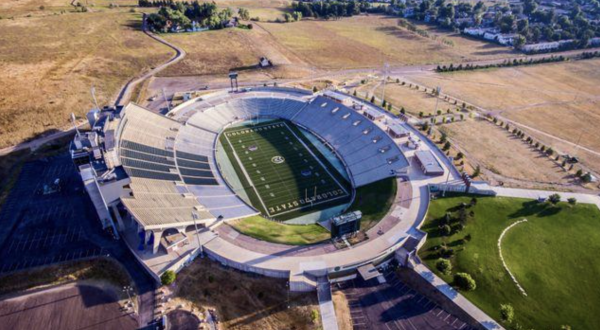
The 2026 college football season gets underway in late August, bringing renewed excitement across the sport. In Fort Collins, that anticipation will build toward September 5, when Colorado State begins its campaign against Wyoming and Rams fans welcome another year of gridiron action.
Yet, when examining the program’s broader positioning in the national championship picture, expectations must remain firmly in check. Between bookmaker odds, statistical projections, and conference standing, the Rams’ 2026 outlook points more toward incremental progress than national championship contention.
Bookmakers Leave the Rams on the Outside
Colorado State sits at +500 000 in the National Championship odds, a number that immediately underlines the distance between the Rams and college football’s leading contenders. The price reflects extremely limited market expectations of a championship run rather than an ordinary underdog position.
That distinction matters. The national title market is dominated by teams carrying established depth, recent high-level results and rosters expected to compete through demanding schedules. Colorado State enters the conversation from almost the opposite end, where outperforming preseason expectations would meaningfully change how the Rams are viewed.
Futures markets also respond to the broader circumstances surrounding a team. Schedule difficulty, coaching stability, and expected roster strength can all influence preseason assessments. Colorado State doesn’t currently have the profile of teams expected to remain in playoff contention throughout the regular season.
So the +500 000 figure is useful mainly as context. It shows how dramatically expectations differ between the Rams and the national favorites before the season has developed. Colorado State can change perceptions on the field, but its starting position is clear: bookmakers see 2026 as anything but a championship campaign.
The real opportunity comes once games begin. Stronger-than-expected performances could gradually narrow that perception gap, giving the Rams a chance to challenge assumptions established during the preseason.
ESPN’s Numbers Point Toward a Difficult Year
The analytical picture is similarly restrained. ESPN’s Football Power Index (FPI) projects Colorado State at around 3.6 wins and 7.5 losses, placing the Rams well below the performance level typically associated with serious postseason contention.
The playoff projection is even more revealing. FPI gives Colorado State approximately a 0.1% chance of reaching the College Football Playoff. In practical terms, the Rams begin the season requiring an enormous departure from model expectations before national championship discussion becomes relevant.
FPI is designed to look beyond a simple reading of last season’s record. ESPN’s methodology considers team strength and uses these assessments to repeatedly simulate the season. The resulting projection provides a probability-based outlook rather than a prediction that Colorado State must finish with a particular record.
That distinction is worth keeping in mind. Models can miss, especially when teams change significantly between seasons. Yet when ESPN’s outlook aligns with the championship market, the broader message becomes difficult to ignore. Colorado State enters 2026 facing considerably more questions about competitiveness than about a potential playoff run.
Exceeding those projections would therefore carry significance of its own. Every additional win would provide evidence that Colorado State is developing more quickly than the preseason numbers initially suggested.
The Pac-12 Provides a More Immediate Test
National comparisons may actually be getting ahead of the story. Colorado State first has to establish itself within a rebuilt Pac-12, and the early projections suggest that challenge will be substantial enough on its own.
The Rams are projected near the bottom of the conference. Oregon State, at roughly 4.4 wins and 6.7 losses in ESPN’s outlook, sits modestly ahead. Utah State is positioned slightly higher again at approximately 4.7 wins and 6.4 losses. None of those projections suggests national dominance, which makes Colorado State’s position particularly revealing.
This is where the 2026 season becomes more interesting than the distant championship price might suggest. The Pac-12’s new structure sets different benchmarks for Colorado State. Progress can be measured against conference opponents facing their own questions rather than exclusively against teams occupying the national top tier.
Still, conference position and national relevance are inevitably connected. A team projected to struggle against its immediate peers has little room to build a convincing playoff résumé. Before Colorado State can seriously enter wider championship conversations, it needs to demonstrate that its place near the bottom of preseason projections understates what it can become.
That makes conference results particularly revealing. If the Rams can outperform teams currently projected above them, their first Pac-12 season could begin rewriting expectations well before the final standings are settled.
Progress May Matter More Than the Destination
It can be tempting to measure every season by whether a team reaches the College Football Playoff. For Colorado State in 2026, however, that would be too narrow a standard, because meaningful progress could come through improved conference results, greater consistency and stronger overall performances.
That raises a more useful set of questions for Colorado State in 2026. How quickly can the Rams become competitive in their new conference? Can the coaching staff establish an identity that holds up across the schedule? And can improved weekly performances begin narrowing the statistical gap highlighted by preseason projections?
Those questions shift attention toward development. Improvement doesn’t have to mean suddenly joining the national elite. Better conference results, greater consistency and stronger performances against demanding opponents can offer evidence that Colorado State is building toward something more sustainable.
Viewed that way, the championship market becomes a reference point rather than the season’s defining story. The +500 000 price and modest FPI outlook establish Colorado State’s starting point. What matters next will determine whether the Rams finish 2026 looking closer to the Pac-12’s competitive middle than the team’s preseason numbers suggest.
Success therefore has several possible definitions this season. A stronger conference position and more competitive performances would represent tangible progress for the Rams, even if the national postseason remains out of reach.
The Bigger Picture Starts Closer to Home
Colorado State is unlikely to shape the national championship race directly if preseason expectations prove accurate. That doesn’t leave the Rams without meaningful objectives. Their first Pac-12 campaign provides plenty of opportunities to establish progress.
For now, the most revealing comparisons are closer to home. Closing the gap with conference opponents, outperforming modest projections, and developing greater week-to-week consistency would all change the conversation. The national picture may remain distant in 2026, but Colorado State can begin building a stronger place within it.