While many pet owners would give anything to keep their furry friend healthy, owners often encounter challenges from a variety of sociological and economic conditions that prevent them from accessing the appropriate care the animal needs.
Accessibility in veterinary medicine was the topic of Colorado State University’s biweekly Ram Talks public lecture delivered April 8 by Dr. Andrew Ciccolini, the medical director of companion animal primary care at the CSU Veterinary Teaching Hospital. He was joined by Dr. Danielle Frey, director of accessible veterinary care initiatives.
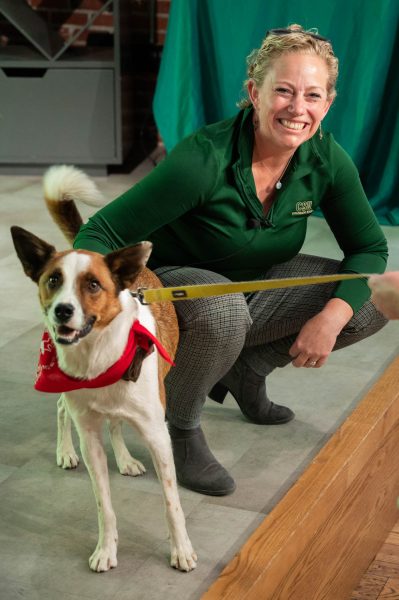
The pair began their lecture by introducing a surprise visit from therapy dogs from CSU’s Human-Animal Bond in Colorado. As the excited audience interacted with the visitors, HABIC Director and Associate Professor Shelby McDonald gave insight into the organization.
“So HABIC has three pillars, and we’re focused on research, education and community engagement,” McDonald said. “Our mission is to improve the quality of life for folks through the therapeutic benefits of companion animals.”
The therapy dogs continued to approach audience members throughout the discussion, with the lectures bringing attention to the numerous benefits people experience from having pets. They also noted the financial challenges some owners experience.
“Pets can really change how we get to engage with the world, and it can help with so many people, and there’s such a big financial piece to it, but everybody should be able to have a pet or an animal in their life if they want one,” Frey said.

The phrase “people shouldn’t have a pet if they can’t afford it,” as Ciccolini said, is often directed at owners who cannot afford high veterinary costs, without accounting for extenuating factors and circumstances that may prevent someone from being able to pay such high prices.
“But think to yourself: How easy would it be for you to face a $5, $10, $1,000 or more emergency bill for your pet?” Ciccolini said. “Yes, many of us will make it work, but it’s difficult, and so expecting everybody to be able to do that is somewhat unrealistic.”
Barriers to care, as the pair explained, are situations and conditions that can prevent someone from properly accessing the veterinary care their animal may need. While these factors include cost, they also account for barriers one may not typically think of, such as transportation.
“Does this person have a car?” Dr. Frey said. “Are they able to hop on the bus with their dog? Do the bus rules allow for dogs to be on the bus?”
Other barriers include location to the nearest vet, time constraints the owner may be under and a potential lack of trust in vets based on previous negative experiences they may have had — conditions that are exacerbated if a language barrier exists.
“If you’re not speaking the same language or culture as this person who’s providing medical care for your beloved human or creature of however many legs they might have, that’s really hard to get across some really complex pieces, and it’s scary to do that,” Frey said. “And for any of us, maybe we’ve gone to see a medical professional and we don’t trust what they’re saying to us. Maybe it was eroded because of something they were saying.”
This lack of accessibility in the field can also have negative effects on veterinarians who may not be able to assist animals they want to because of these constraints.
“We think it’s really important to point out the impact this has on veterinary professionals as well,” Ciccolini said. “It can be draining, doing this day in and day out, dealing with difficult and sad cases, being trained to provide the top-level medicine possible but not being able to provide it.”
To counteract these barriers, CSU’s veterinary students are educated in the Spectrum of Care, a range of treatment and diagnostic options that can be recommended to owners, accounting for their socioeconomic backgrounds. These options are broken into three categories: incremental care, contextual care and option-based care.
“(The system) acknowledges multiple acceptable care options, tailored to unique contexts, barriers and goals of each patient, client and veterinarian,” the Ram Talks lecture slide read.
To counter language and cultural barriers, CSU also offers a Spanish for the Veterinary Professional program. Frey, who helped to develop the program, explained how it allows students to engage with clients in Spanish while gaining cultural understanding.
The Veterinary Teaching Hospital is also undergoing a curriculum change in teaching primary care to better prepare students with experience in a hospital setting — directly interacting with owners and their varying circumstances — before they enter the field full-time.
“We’re putting a very heavy emphasis on them getting experience in primary care, which is where I live, and when they’re there, they get to be the doctor,” Ciccolini said. “They’re making the decisions. They’re the one examining the pet, providing the care, and we’re there to support them, and we feel like this is a much better way to help them learn.”
Reach Katie Fisher at science@collegian.com or on social media @RMCollegian.