

Love is in the cash this Valentine’s Day as local businesses prepare to meet the demand for gifts and sweets during the week leading up to Feb. 14. A January survey by the National Retail Federation found that consumers are projected to spend around $29.1 billion on products during the holiday, with 56% of those spenders predicted to buy candy.
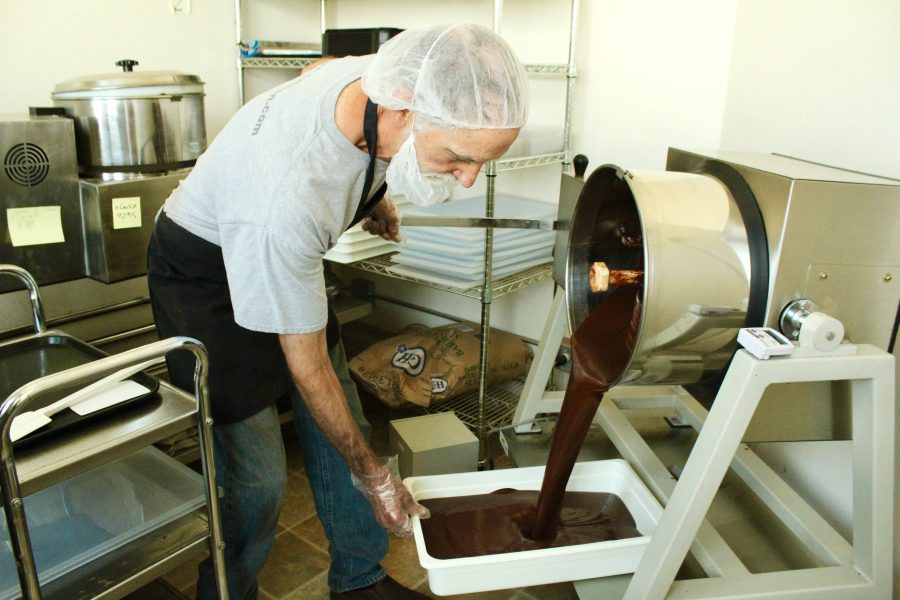
Nuance Chocolate, a bean-to-bar chocolatier in Old Town, is helping to fuel the nation’s need for sweets. Married duo Megan and Tyler Ryan took ownership of the store around 10 months ago.
Tyler Ryan said that although Christmas is the biggest chocolate-selling season, Valentine’s Day comes in second place in the holiday chocolate Olympics. In fact, he said he estimates Nuance has around two-to-three times more customers entering the store per week, compared to the average number.
“We definitely see an uptick in new customers,” Tyler Ryan said. “But we definitely get a lot of our returning customers who come back to pick up some gifts for their friends, family and loved ones.”
These regular customers, or as Nuance refers to them, “chocoholics,” primarily drove the marketing of Nuance through word-of-mouth until the new owners entered the social media scene. Tyler Ryan said he recognizes that this kind of brand loyalty is unique to small businesses and hopes to keep Nuance the way it is.
“I don’t want Nuance to be a giant wholesaler where you only just see our bars in stores,” Tyler Ryan said. “I love the fact that I know every single person (who comes into) the business.”
However, keeping up with demand during rush seasons is noticeably harder for smaller businesses than for larger chain brands. Professor of supply chain management at Colorado State University Zac Rogers described the logistics of Valentine’s Day for small businesses like Nuance all over the world.
“We sell too much chocolate, which is a good thing, … but sometimes there’s the stress of walking into the business and seeing half your plates empty. I wish those plates were full so that people can keep enjoying the chocolate, so that’s kind of the balancing act.” -Tyler Ryan, Nuance Chocolate co-owner
“The trick for smaller companies is that it can be harder for them to get stuff moved, especially if there’s a lot of demand on transportation,” Rogers said.
This type of high demand is especially complicated during Valentine’s Day and other highly consumer-based holidays.
“If you’re a big company, like Amazon or Costco or Target, you probably have contracts,” Rogers said. “You can get a better deal on the truck. … That can be tough for smaller firms because they tend to have less cash on hand than the bigger guys.”
Unlike the big guys, small businesses are far more likely to collaborate to avoid these demand struggles.
“That is really the nature of small businesses,” Rogers said. “I’d be surprised if there was any one refrigerated truck coming in to just one small business. Probably what happens is they say, OK, we’re going to get a truck with these flowers on it. Who else needs flowers? Let’s all go in on the truck coming up from Denver together.”
The preparation for Valentine’s Day isn’t the only demanding part of the season for businesses. Rogers also explained how the rise in profits for these stores can influence their spending habits.
“It doesn’t necessarily change, but they know they have big days coming,” Rogers said. “We’ve been working this whole year with the assumption that we are going to make money on these days, and now our systems can work the way we want it to.”
For small businesses, there is more direct control in what those big days are used for. For example, when the store experiences a rise in profit — such as Valentine’s season — the extra cash can allow businesses to buy more ethically sourced materials and engage in more sustainable practices.
“That enables us to buy more beans from the Dominican Republic of Zorzal, which ends up supporting bird habitats, which is really cool,” Tyler Ryan said. “We compost pretty much everything that we have. The only wastes we really have are the plastic gloves and the hair net that we’re required to have by the FDA.”
A push for greater sustainability among large sellers over the past decade has paved the way for stores like Nuance to access to better options in their own supply management.
Still, before the profits from Valentine’s Day can be invested back into businesses, owners have to face the odd feelings that accompany high demand and the race to meet the supply.
“We sell too much chocolate, which is a good thing, … but sometimes there’s the stress of walking into the business and seeing half your plates empty.” Tyler Ryan said. “I wish those plates were full so that people can keep enjoying the chocolate, so that’s kind of the balancing act.”
Reach Maiya Kreamer at news@collegian.com or on social media @RMCollegian.