

Al Hubbard is a Northern Arapaho and Navajo artist. Hubbard currently works for Central Wyoming College as a tribal education assistant, collaborating with his community to educate, create and provide insight on what it is to be Indigenous today.
“I’ve worked for the Northern Arapaho tribe in different capacities, but this is probably one of the most rewarding because I’m involved in education; I’m able to flex my creativity,” Hubbard said. “First and foremost, I consider myself a contemporary artist, and that’s always been a part of who I am, without question.”
Hubbard grew up in Idaho and Las Vegas but moved to the Wind River Indian Reservation in Wyoming with his mother in his late teen years, as his mother was Northern Arapaho and his father is Navajo. This move, Hubbard said, allowed for him to “really embrace the culture, but it was a culture shock, you know? Growing up in Last Vegas, and we moved to a small town in Wyoming.”
Though Hubbard did not grow up on the Wind River Reservation, he still felt a connection to the communities and continues to live on the Reservation today.
“Even though we didn’t live on a reservation, my mom and my dad would take us back to the reservation every summer, and so we got to know our relatives, and we got to know who we were related to really and take part in different activities that kind of grounded us as we grew up outside the reservation,” Hubbard said.
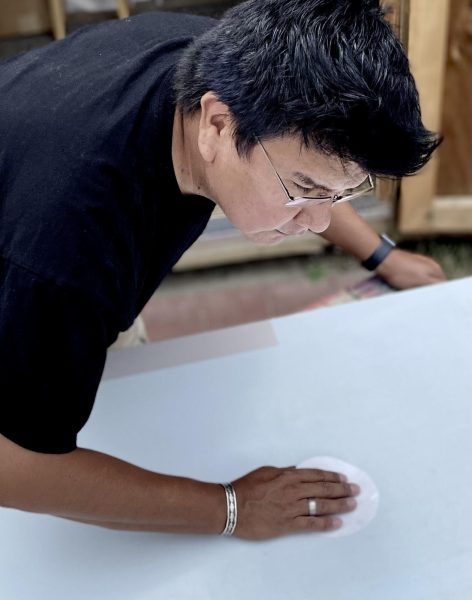
Hubbard said he planned to leave Wyoming to attend an art school in New York but ended up at the Institute of American Indian Arts in Santa Fe, New Mexico, where he began to find his creative style.
“That’s what really challenged me,” Hubbard said. “Before, I’d always been, like, a realistic, kind of cartoony artist, and I thought that’s what art was supposed to be. (IAIA) challenged your perceptions, they challenged who you were, your identity, and it only strengthened your research for your tribal history and culture. And that’s what I started to really get excited about — making things that told stories about who I am historically, my bloodlines, the concepts, social structure, all of that wrapped up into a painting or a sculpture.”
For Hubbard, his future as an artist was never a question. He knew he wanted to create from a very young age, feeling the need to make art with his hands and allowing it to help him get out of his head.
“When you think a lot, you need an outlet or you need to get it out of your brain,” Hubbard said. “So maybe art was a result of my overthinking, or maybe my overthinking was because of my art.”
A collection of Hubbard’s art called Reclaiming Oblivion can be found in the Duhesa Gallery in Colorado State University’s Lory Student Center. Hubbard’s installation, “Resilience,” is featured in the Duhesa Gallery and includes cheese boxes strewn about on fake grass.
“My hope for my work is to create dialogue. …We live in a time where there is a lot of divisiveness, a lot of division and a lot of hate. A lot of quick answers or first thoughts are deciding how we communicate with each other. I think that it’s time that we start slowing our thoughts down and allowing space and allowing people to exist within our space.” -Al Hubbard, Indigenous contemporary artist
“There’s a long history of commodities on reservations, and part of that is how food was delivered on reservations, but also inherent is the way that it really short-circuited their ability to use traditional ways of gathering and acquiring food and made them incredibly dependent on the government,” said Doug Sink, the LSC Arts Program manager.
Not only do Hubbard’s experiences and identity shine through in his work, so do themes of Indigenous history and social issues. Hubbard said he hopes to both share his experiences and the experiences of those around him through his art.
“Being involved in the community, you see all of the issues that pertain to contemporary life on an Indian reservation,” Hubbard said. “That could be anywhere from protests, anti-government, pro-government, politics, social structures, tradition — all of these things are wrapped up in our lives every day living on a reservation. Being able to tell a story about the everyday is something that I find very interesting.”
Hubbard tackles the complex issues facing Indigenous communities today, including living on a reservation and what it is to be Indigenous.
“We tend to separate them (Indigenous people and their communities) and institutionalize them as a historical past or something that has happened a long time ago,” Hubbard said. “We don’t really get to see the living culture of today. One of my main goals is to make sure that we were talking about today.”
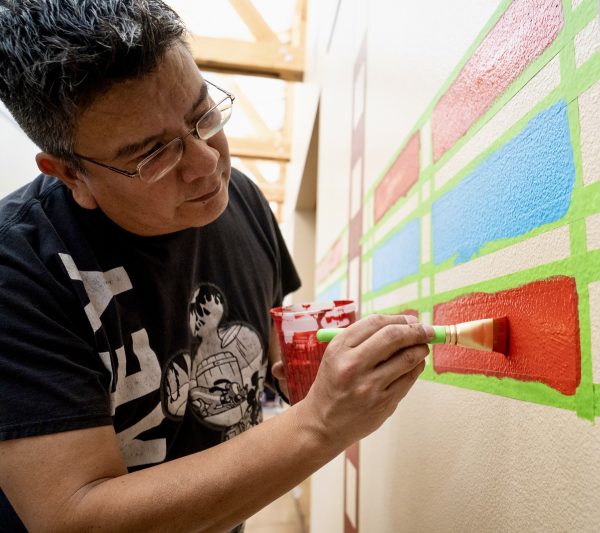
Grief has also shaped Hubbard’s art in more ways than one. His family has had great influence on his creative career; having endured the loss of his sister and mother in recent years, he said his art became a priority and a grounding force through his losses, allowing him to be rooted in his art as well as his grief.
“(My sister) was a big part of me as an artist because she really supported me throughout my life,” Hubbard said. “And once we lost her, I made the decision to not go back to corporate jobs. I wanted to spend a year just producing meaningful work. Once I made that decision, it’s just been one show after the other. It was kind of like the universe telling me, yes, this is the path that you should have been on.”
Hubbard said he hopes to continue making space for his work to evolve and grow. His next solo exhibition will be in Jackson, Wyoming, this spring.
“My hope for my work is to create dialogue,” Hubbard said. “We live in a time where there is a lot of divisiveness, a lot of division and a lot of hate. A lot of quick answers or first thoughts are deciding how we communicate with each other. I think that it’s time that we start slowing our thoughts down and allowing space and allowing people to exist within our space.”
Reach Gracie Douglas at entertainment@collegian.com or on social media @RMCollegian.