

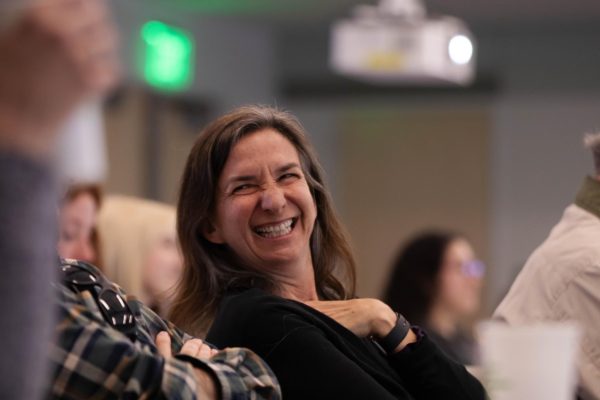
Colorado State University biology Professor Alan Knapp convened with students and professors Jan. 27 to deliver a lecture on the impact of solar energy development on land management and ecosystems.
The lecture, titled “Colorado’s Transition to Solar Energy: An Ecological Perspective,” discussed topics relating to solar energy, particularly its growth and impacts on the environment where the technology is implemented.
“I just want to talk about this transition to renewable energy, primarily solar energy, both globally as well as in Colorado,” Knapp said. “I want to talk about some of the optimistic points, the pessimistic points and the uncertainty that’s involved with this transition.”
Solar energy is seeing rapid growth in Colorado and around the world. Knapp said that 11% of Colorado’s energy is currently provided by solar panels, that 25% of the world’s solar energy came online in 2024 alone and that Earth is projected to generate a majority of its electricity with solar energy by 2030.
“They’re poised for tremendous growth in this particular field,” Knapp said. “You probably realize it because you’ve driven around Colorado before, but solar is already here in Colorado.”
Knapp reflected on the land management required to sustain such rapid growth in solar energy. From this land use, there are environmental concerns from ecological experts, even those in support of renewable energy, which Knapp calls “ecological NIMBY-ism.”
The philosophy, which references an acronym meaning “not in my back yard,” refers to when local residents of a region are opposed to renewable development due to potentially negative environmental impacts.
“What (Knapp) said is really relevant about (how) solar farms are becoming, like, a new biome. Introducing them as their own little ecosystem and how they interact is going to be more relevant as we take up more land with them.” –Kathleen Condon, CSU Ph.D. candidate
“All of my ecology colleagues are like me; they’re pro-renewable energy,” Knapp said. “But I have a colleague in New Mexico, and when a large solar array went into the native systems in New Mexico, you would not believe how unhappy he was about that happening.”
The latter half of the lecture focused on a study Knapp took part in at Jack’s Solar Garden near Longmont, Colorado, where he measured the health of grass and soil that lie below and in between solar panels.
“We got to these solar arrays and we sampled them,” Knapp said. “We measure quantified light environments (and) how soil moisture is impacted. We focused a lot on the physiology of the grasses growing underneath them, how are they impacted by these changes in the environment and how does that then translate into the productivity of the grasses that are under, as well.”
Knapp said he found that variance in factors like rainfall and shade from the solar panels affected plant growth around the solar farm. Specifically, below-average rainfall caused an increase in growth in plants around the solar farm relative to nearby open grassland.
The issues of solar growth, as well as its solutions, are of use to the department of biology beyond Knapp’s research. Joe von Fischer, a professor in the department of biology and the lecture’s host, researches grassland ecology and said he is interested in using Knapp’s findings in his own teaching.
“I teach Intro to Bio, which is LIFE 103, and that would be a place where I could talk about how plants grow and how the cohabitation of grasslands and solar arrays would work,” Fischer said. “I also teach a graduate class in ecosystem ecology, and I would bring these concepts in as well.”
Knapp’s lecture and the research that led up to it captured the high-level thinking that is put into maintaining environmental well-being when increasing land use for solar farming.
“What (Knapp) said is really relevant about (how) solar farms are becoming, like, a new biome,” said Kathy Condon, Ph.D. candidate at CSU. “Introducing them as their own little ecosystem and how they interact is going to be more relevant as we take up more land with them.”
Reach Robert Sides at science@collegian.com or on social media @RMCollegian.