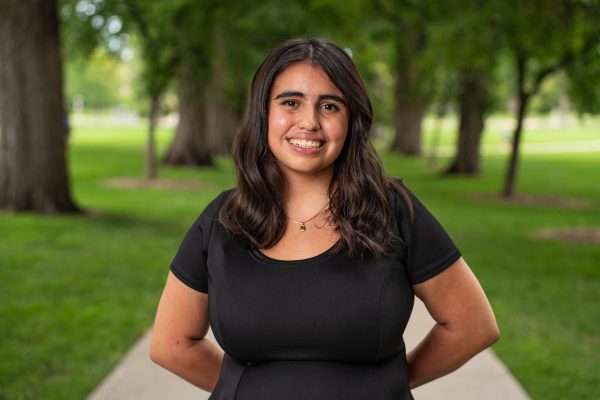


As a Colorado State University doctoral candidate and graduate teaching assistant in the department of biology, Beth Wittmann is a self-proclaimed “odd-ball” in her field.
Motivated by the disabled people in her life and her interest in STEM, Wittmann has combined her interests in her academic career to explore oppression and social justice in science through an interdisciplinary lens.
“The fingerprints of the scientists of the past are all over the science that we do today,” Wittmann said. “In science, we often are thinking about the future and moving forward and what’s next and what’s new. And those are, like, the flashy things that often get funding and publishing. But I’m really interested in science and history, which there often isn’t as much opportunity to learn.”
Wittmann’s three-part dissertation dives into this topic, evaluating the entanglement of how society defines healthy bodies and who belongs in nature. Through a historical lens, the first part of the dissertation looks at how fat bodies and health were perceived from the 1800s to the 1900s, connecting it to the beginning of the conservation movement.
The second part continues to evaluate how conservationists from the same time period invested in eugenics.
“Both movements are about population control,” Wittmann said. “The same people from both movements felt privileged enough to decide that they could get to control both human and animal populations and decide who were the best in the population that we should keep and have reproduce.”
In terms of her work, Wittmann compares the importance of historical context to a rowboat.
“A lot of this work has been about letting disabled students know, … ‘We know that you’re going to be here, and we’re prepared for you.’” –Beth Wittmann, biology doctoral candidate
“In a rowboat you’re sitting backwards, and when you row, you move forward,” Wittmann said. “I’m always looking at the past as I’m moving forwards to be grounded in the history and the knowledge from that as I make steps towards the future and imagining what is possible.”
The third part of Wittmann’s dissertation begins to touch on the future. Wittmann has interviewed 16 self-identified fat or larger-sized people about their experiences in nature. There is a crossover between the oppression of fat people and disabled people, Wittmann said.
“They’re really almost like sisters or cousins, in part because fatness can be disabling, and disability can be fattening,” Wittmann said.
The two also overlap because both identities can change over time, and both deal with accommodations and the barriers that come with receiving accommodations.
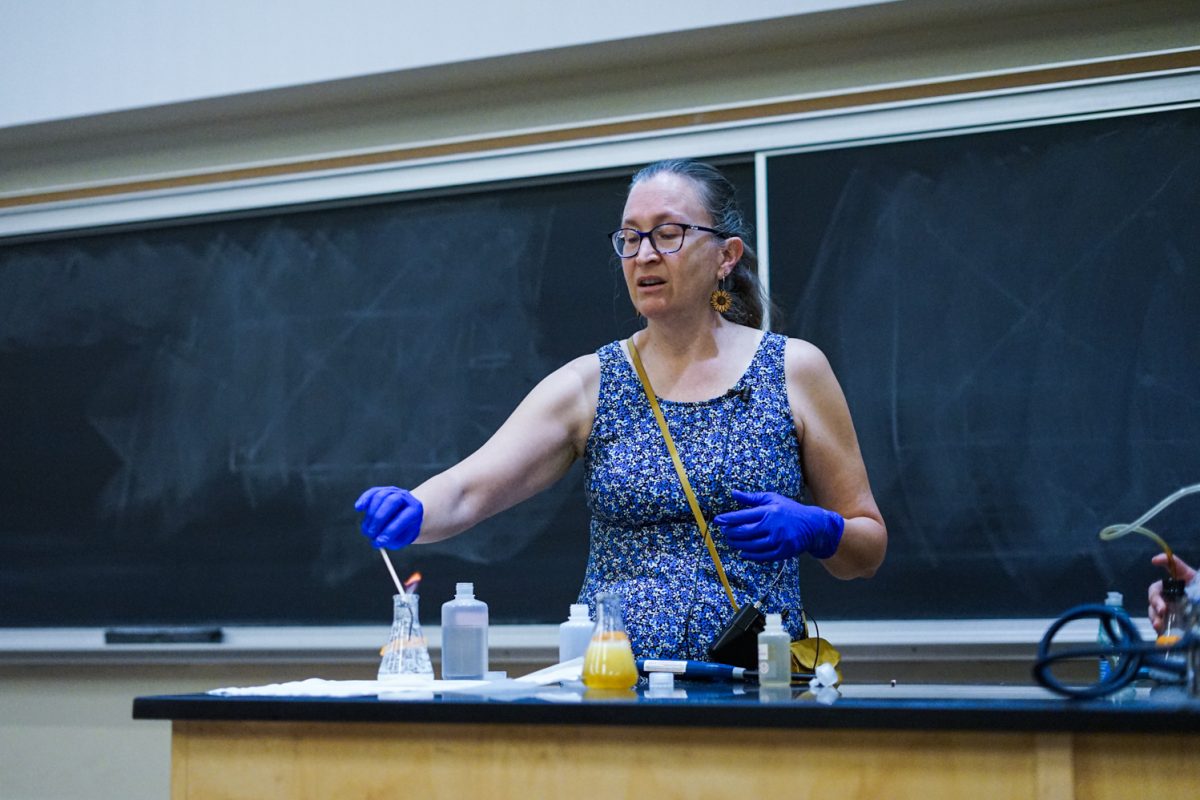
Over the past six years at CSU, Wittmann has found various ways to create awareness about issues like these and promote accessibility across campus, such as developing electronic accessibility, designing a protocol for service dogs to be in lab settings with the Student Disability Center and investing in protective lab gear for service animals.
“A lot of this work has been about letting disabled students know, … ‘We know that you’re going to be here, and we’re prepared for you,’” Wittmann said.
Wittmann has been supported in this process by her adviser, Deborah Garrity, the chair of the department of biology, who has helped advance efforts such as providing lab gear for service animals.
“I’ve always sought to appreciate and to support (Wittmann’s) own original idea for her research and within our ability to give her good guidance, to give her quite a bit of agency to pursue the directions that she is most interested in,” Garrity said.
Garrity has also been a part of developing a graduate course that Wittmann has co-designed and co-instructed for multiple years. The course examines systems of oppression in science.
As Wittmann prepares to graduate in the spring, there are a number of lessons she said she has learned throughout her time as a doctoral student, including the importance of having a strong community in graduate school. Among a long list of names, Wittmann gives credit to mentors like Garrity.
Wittmann also specifically noted Rickey Frierson, CSU’s assistant vice president for strategic student success initiatives and former assistant dean of diversity and inclusion, as someone who had a huge influence on her and her efforts at CSU.
“He was like, ‘No, no, no, if you don’t see it where you are, build it,’” Wittmann said. “I really took that to heart, and that’s one of the reasons I started the class and have been doing this accessibility work.”
With a variety of future endeavors, including continuing to work with disabled people, turning her dissertation into a book and pursuing postdocs, Wittmann said she aims to continue her commitment to diversity, equity and inclusion.
“My commitment to that doesn’t waiver or vary based on the federal administration (or) whoever is in office,” Wittmann said.
Reach Chloe Rios at science@collegian.com or on social media @RMCollegian.