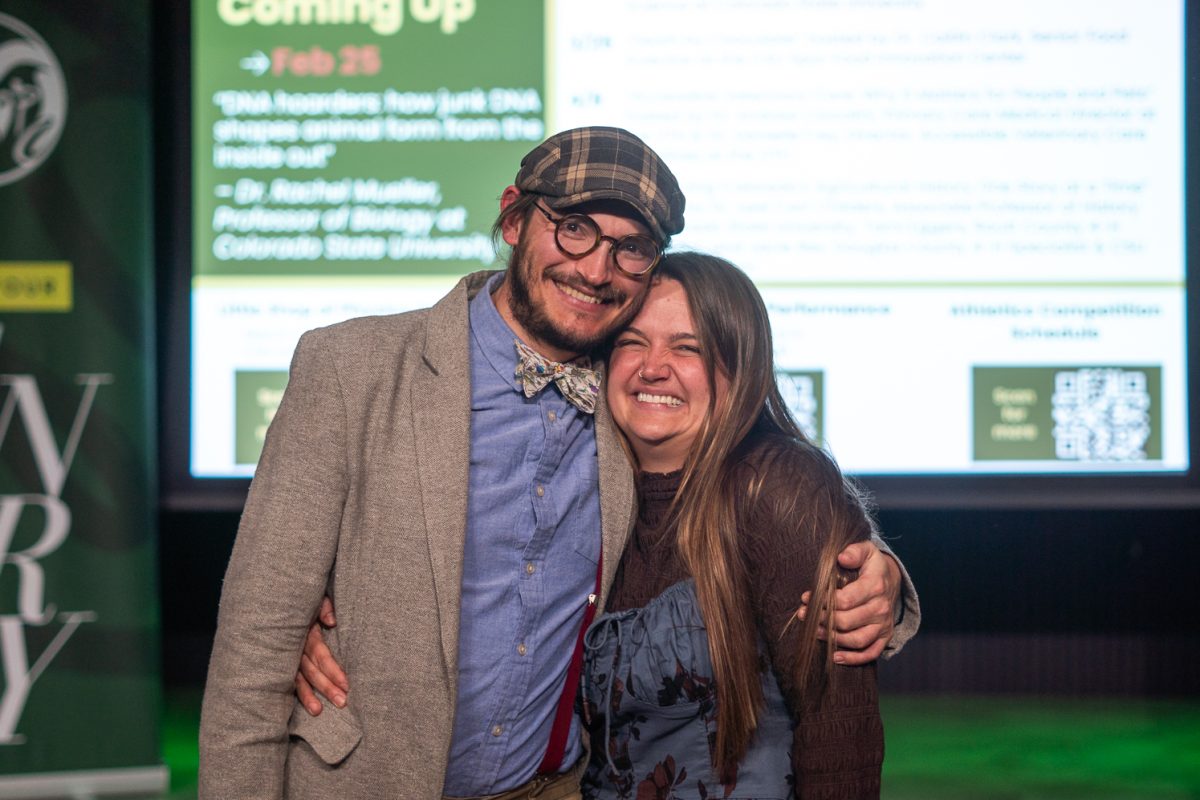

The majority of DNA in one’s body does not encode for any protein. In a Feb. 25 lecture, Rachel Mueller, Colorado State University biology professor, addressed questions surrounding junk DNA, including what it is and why it is present.
“I just loved the idea that not all DNA was informative or critical for the organism,” Mueller said. “I went back to grad school and I got my Ph.D., and I focused (on it). I chose to focus on salamanders.”
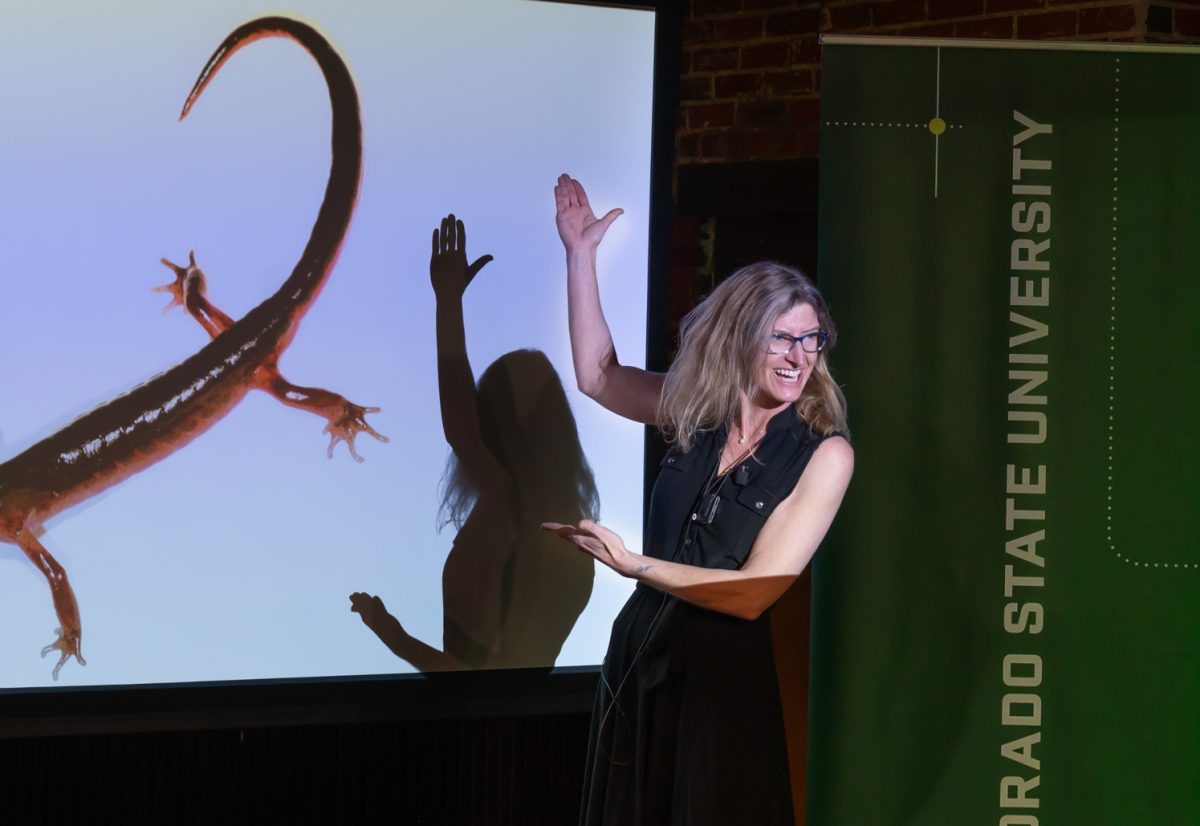
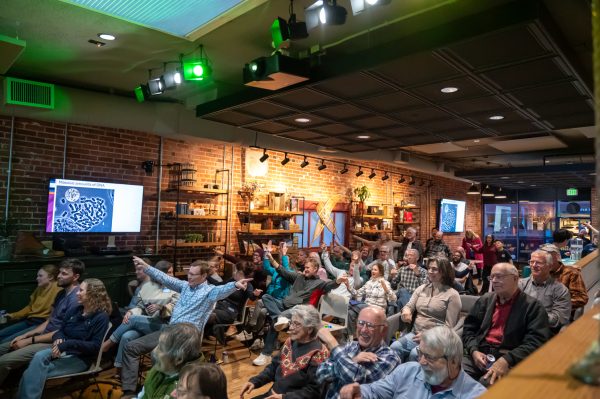
The Ram Talks lecture began at the Fort Collins Welcome Center, with a large salamander plastered on the screen behind Mueller as she brought audience members with her into the world of DNA, recipes and paper bags.
A primary focus of Mueller’s talk relied on her lab, which looks at salamanders and their unusually large cells filled with up to 40 times the amount of DNA as in human cells.
“(Salamanders) have a typical body plan, no shell, no wings, no horns, none of that stuff, just four legs and a tail and a head and a body,” Mueller said. “But under the hood, their cells are really unusual, and things start to get really weird in salamanders.”
Mueller asked the audience to question why having more DNA means bigger cells, along with why salamanders have so much DNA in comparison to humans and other species.
“The picture of the size of the blood cell of a salamander versus the human cell … was so much bigger; you just wouldn’t expect that,” said Craig Bryant, an alumni who is attempting to attend all the Ram Talks lectures.
Mueller related junk DNA to human hoarding; some of the junk is useful, some harmful and some does not affect us at all. She discussed and critiqued the two main metaphors used to describe DNA: the blueprint and the cookbook. Both of these examples explain information as being stored, but what about the more than two-thirds of junk DNA sitting in our bodies?
“I wanted (the audience) to understand their place in the history of life on Earth. And I wanted them to have a better understanding of their own cells and their own DNA and just how much complexity there is in every single human cell, and how it can be sometimes unintuitive. But I think the more you know about yourself (and) how your body works, the more amazing it is.” -Rachel Mueller, CSU biology professor.
“DNA is a messy pile of paper with some critical notes hidden in it,” Mueller hypothesized.
Members of Mueller’s lab have said the salamander’s heart is like a paper bag. Negative space between cells occurs where the DNA in the heart is larger. Originally, her lab had not expected the heart to have large spaces, where it looks like the heart should barely function.
“(Salamanders) are OK with junk DNA, big cells and flimsy hearts!” Mueller’s slide presentation read. She noted that humans, on the other hand, would not be OK with the heart makeup because human bodies demand more.
Mueller explained this phenomenon by noting that salamanders are in no hurry. She compared a group of humans using screens to the salamander, mentioning their low-energy lifestyle and their cells’ ability to be big, clunky and not structurally impressive.
“Salamanders are pretty weak in terms of their whole body structure,” said Andre Comeaux, a junior majoring in fish, wildlife and conservation biology at CSU.
Humans simply have greater demand and need a greater supply than the salamander.
“I like to think of (salamanders) as showing us what our own DNA would actually be up to if it weren’t constrained by the demands that our own physiology (and) our metabolic rate places on it,” Mueller said. “(If) the DNA were just left to its own devices, this is what it would be doing.”
The bimonthly Ram Talks Series bring the community together in conjunction with experts like Mueller.
“I wanted (the audience) to understand their place in the history of life on Earth,” Mueller said. “And I wanted them to have a better understanding of their own cells and their own DNA and just how much complexity there is in every single human cell, and how it can be sometimes unintuitive. But I think the more you know about yourself (and) how your body works, the more amazing it is.”
Reach Abby Barson at science@collegian.com or on social media @RMCollegian.