

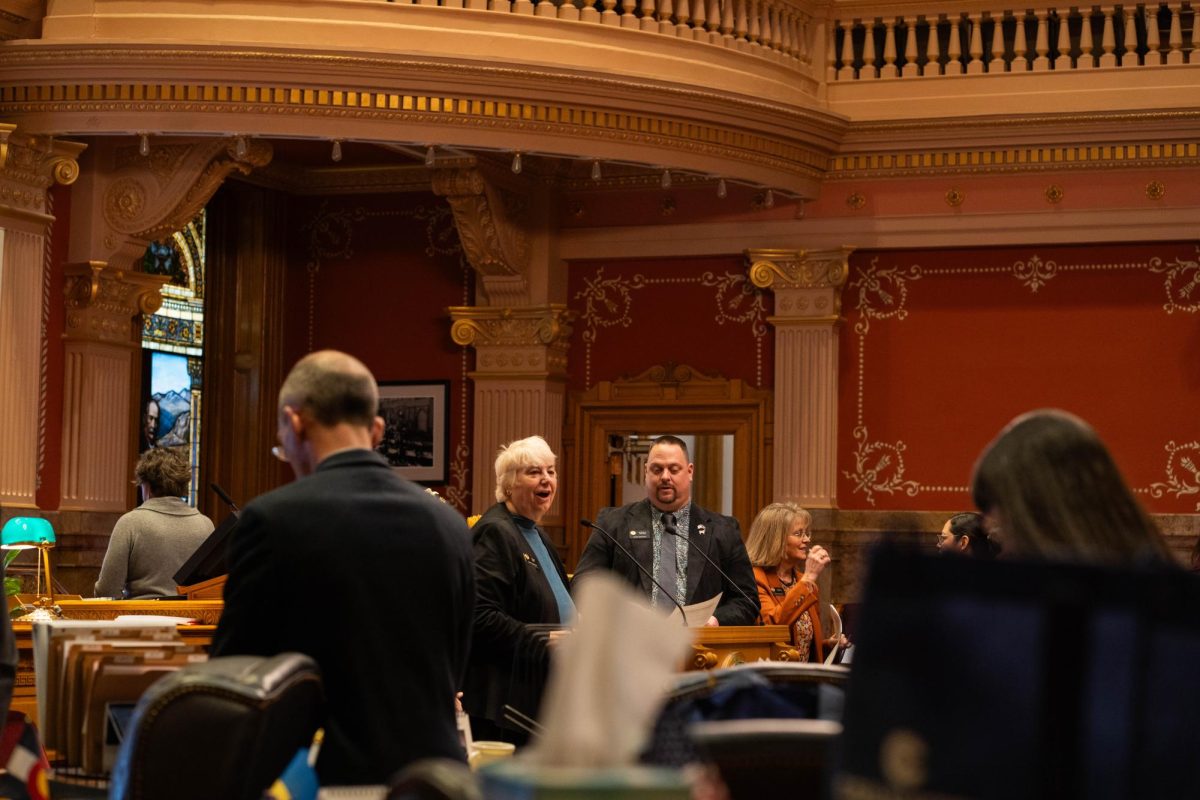
Colorado’s Senate Committee on Local Government & Housing unanimously voted Thursday not to advance a bill proposed by Sen. Cathy Kipp that would have required Colorado State University to comply with local sign and noise codes.
Committee members heard a dozen opposing arguments and eight in support of the bill before voting against it, ultimately citing concerns that the bill is too locally focused, hard to enforce and could prevent CSU from effectively utilizing taxpayer revenue.
“What I’ve seen is when these issues come up, by and large, locals can work them out themselves,” said Sen. Marc Snyder. “I admire you for bringing this bill. It’s too broad and too narrow at the same time. … I think the effects this bill would have on other parts of Colorado who might not be experiencing an issue like you all are, up there in Larimer County, concerns me.”
Kipp said she proposed the bill in January after hearing from constituents who were bothered by loud nighttime stadium events and the multiple electronic billboards that CSU erected throughout campus property, most of which are visible to the surrounding community.
Fort Collins has prohibited such conduct for decades, but CSU is on state-owned land and not subject to city ordinance. If passed, the bill would have required the university to comply with all noise and sign regulations if the violations in question could be observed off campus. The city could offer waivers if requested.
“Right now, CSU holds all the cards — communities have no leverage and no recourse,” Kipp said. “This bill doesn’t take away anything from CSU. It simply requires that our neighbors be treated as neighbors.”
Proponents of the bill argued CSU had disregarded the long-held values, livability and safety of the surrounding community without giving impacted residents a way to negotiate disturbances. Kipp said CSU had been unfair to its neighbors, acted in excess and refused to acknowledge its harm.
“Underlying all of this is a pattern of how CSU has engaged or failed to engage with its neighbors,” Kipp said. “The reason this bill exists is that CSU’s behavior and attitude have left our residents with no other option.”
Opponents framed the bill as a potentially dangerous reconfiguration of jurisdictional power, warning that it could give local governments regulatory authority over state institutions. Jia Meeks, a lawyer for CSU, read a letter to the committee written by CSU President Amy Parsons.
“This bill establishes a concerning precedent that spreads beyond CSU by subjecting state institutions to local government regulatory authority, undermining the university’s constitutional standing as a state entity,” the letter reads. “The Board of Governors, the CSU System and CSU operate facilities across the state — including CSU Pueblo, CSU Spur in Denver, 10 Agricultural Experiment Stations and extension offices in 55 counties — meaning the CSU enterprise would be subject to dozens of municipal ordinances that could vary significantly and change with each local election cycle.”
Joe Rowan, board member of Northern Colorado Legislative Alliance, read a letter written by the Fort Collins Area Chamber of Commerce CEO Ann Hutchison, warning that copycat legislation could affect state agencies beyond CSU.
“If allowed to stand, there is no foreseeable end to copycat legislation that would expand upon this measure for any number of real or perceived annoyances,” the letter reads.
Kipp argued CSU’s billboards have so far been used mainly for advertising purposes, giving the university and its advertising partners an unfair economic advantage that has long been denied to local businesses. But restricting university operations, opponents argued, could detrimentally limit the tax revenue and local spending brought in by university advertising and events.
“In 2025, Canvas Stadium generated $38.4 million in direct spending in our local economy,” said Cynthia Eichler, president and CEO of Visit Fort Collins. “Canvas Stadium at Colorado State University is not just a venue for football; it’s a gathering place for meetings. … We believe those things are very important to the fabric of our community, and we believe that this bill could threaten that significantly.”
Brendan Hanlon, CSU’s chief financial officer, said revenue from the billboards is essential to mitigating recent budget reductions that could impact campus safety.
“Revenue generated through the signage partnerships is directly invested in campus safety infrastructure, including safety enhancements,” Hanlon said. “That revenue is limited. Safety enhancements would need to be funded through the university’s operation budget, which is currently undergoing a budget exercise to reduce approximately $48 million in spending for fiscal year 2027.”
According to The Coloradoan, CSU paused additional billboard installations the week before the hearing. As of March 1, it is unclear if the university will resume further projects now that the bill has failed.
Reach Chloe Waskey at news@collegian.com or on social media @RMCollegian.










Devy Ballard • Apr 5, 2026 at 8:46 pm
Those stupid billboards shouldn’t be allowed *anywhere*, and they shouldn’t be on my college campus.