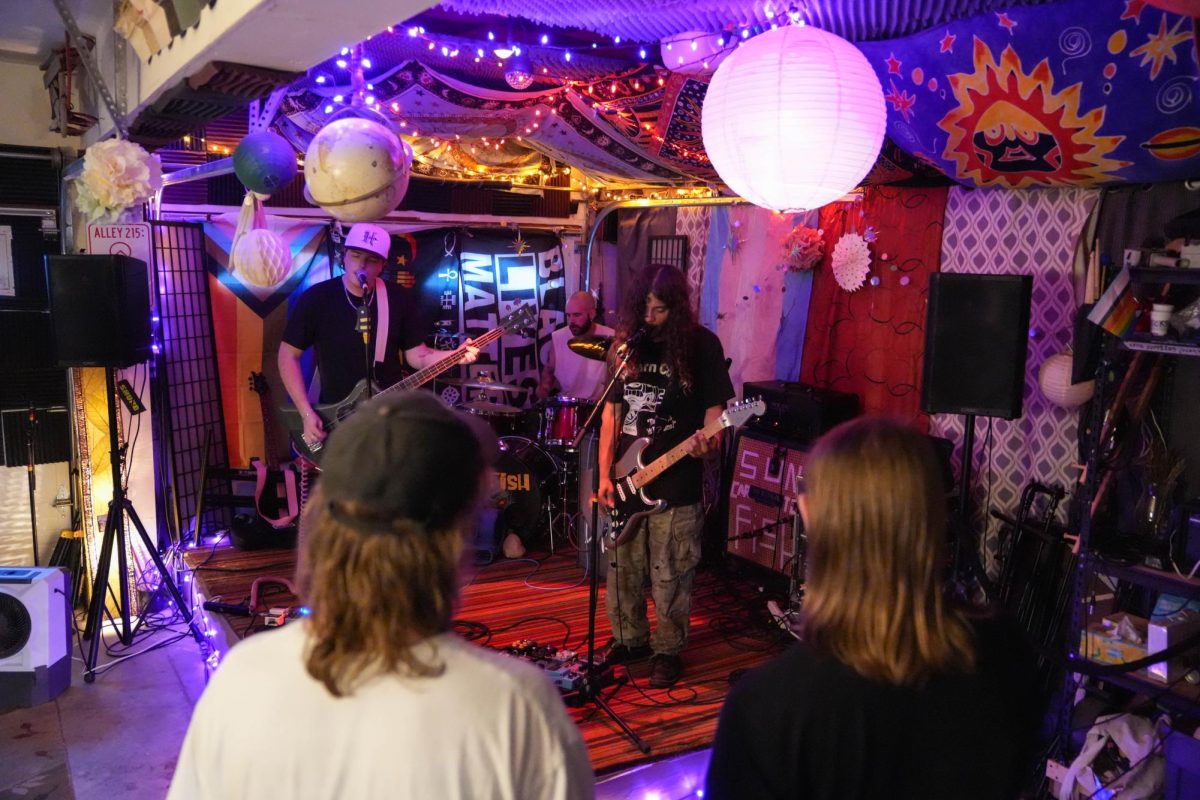


On Monday evenings, The Lyric in Fort Collins holds an open-mic session for songwriters and musicians to perform for the public. While most musicians who attend the open-mic sessions come and go week by week, one duo — songwriter and guitarist Alan Anderson and bassist Edwin Chong — stands out for both their consistency in performing and the political focus of their music.
Together, Chong and Anderson formed a band with another musician called Choice City Trio, whose music makes an impact not only with its powerful sound and lyricism, but with the voice their music gives to today’s political issues.
On Feb. 2, as Chong and Anderson took to the stage, Anderson propped a red cardboard “No Kings” protest sign behind the instruments and mic stands. The duo then proceeded to perform a set almost entirely comprised of political protest songs.
Anderson, who began creating music and writing songs at the age of 14, said his true passion is to create love songs but writes protest songs when he feels called to speak out.
“It’s strange times, and I feel a compulsion to play these (protest songs),” Anderson said.
Since the 1980s, Anderson has performed songs about the concerns he feels morally obligated to share. He discussed how he initially wrote the song “People with More” in response to the United States bombing of Iraq; however, he feels that the lyrics of the song still ring true today, and he included the song in his setlist for the open mic Feb. 2.
Speaking on why he continues to write political songs, Anderson said, “When I saw what (U.S. Immigration Customs and Enforcement) was doing, I was compelled.”
“I can do something with my hands, with my art, with color when something upsets me. I can react.” -Alan Anderson, musician and vocalist
This compulsion led Anderson to record another original song titled “Burning Kite,” which discusses the recent actions of ICE.
When asked to comment on the song, Anderson noted his reaction to witnessing recent news reports of ICE in Minnesota, saying, “I’m terrified. I’m thoroughly frightened. I can’t imagine what it must be like for the people on those streets.”
Anderson and Chang’s set also included a rendition of “Streets of Minneapolis,” a newly recorded protest song by Bruce Springsteen.
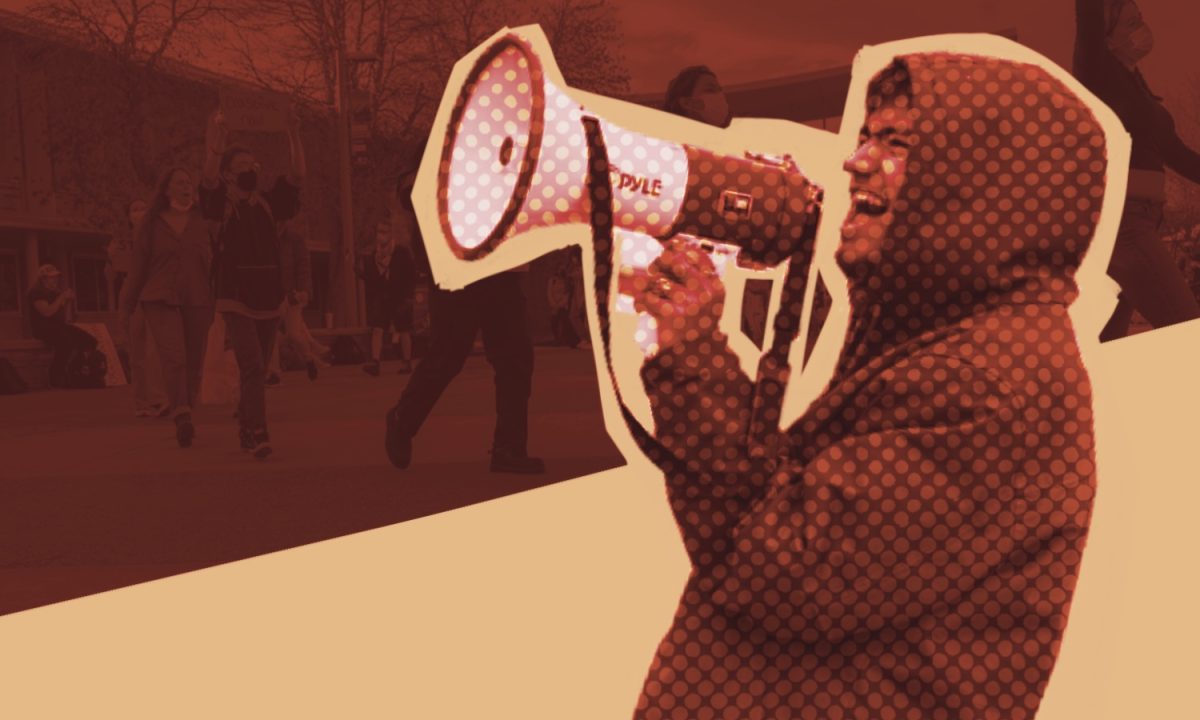
“Protest art is vitally important,” Anderson said. “If you look, you will see that protest art persists over time.”
Protest art proves to be vital to the utilization of free speech — a key aspect to this country’s democracy.
“It ought to be a right, but lately it isn’t,” Anderson said about free speech.
However, Anderson expressed his belief in art as a means to exercise the right to free speech and said he views protest art as a path to protecting this essential right. While the voice of an individual can only extend so far, art’s impact is immortal and far more difficult to silence.
In addition to protest songs, Anderson and his wife, Sue James, create buttons with political messages to give out to the public.
Anderson sees the act of creating protest art and distributing it as therapeutic.
“I can do something with my hands, with my art, with color when something upsets me,” Anderson said. “I can react.”
While many current events seem out of the general public’s control, it’s possible to take initiative and have an impact in one’s community through actions like Anderson’s art.
“I figure, each button that goes out to someone who’s going to wear it will start a conversation,” Anderson said. “And that’s a good thing. And I can facilitate that just a little bit, but I don’t have to be there.”
Anderson said he and his wife have given out around 1,500 buttons with the hope that each one may encourage discussion.
“There’s a spark,” Anderson said. “There’s something that gets it started.”
Every time Anderson gives a button to somebody, he tells them, “Don’t give up.” He said this because “if we don’t (give up), it may take a long time and it may be harsh, but we can get through this.”
Reach Addie Mitchell at entertainment@collegian.com or on social media @RMCollegian.