
Walking into the Museum of Art Fort Collins’ newest exhibition, “Installation Nation,” feels less like entering a gallery and more like stepping into another ecosystem.
The show, on view through March 15, brings five local and regional artists together to explore installation art, the environment and nature through atmosphere, sound and embodied experience. Across its rooms, the exhibition repeatedly gestures toward nature’s earliest forms, inviting visitors to feel connected to aspects of life much older than humanity itself.
Installation art moves beyond traditional paintings and sculptures to surround viewers instead of remaining at a distance — something visitors immediately notice upon entering.
“As soon as I walked in the space, I felt a sense of depth that’s hard to put into words — sort of a sense of comfort that came with being in the middle of an art piece,” said Tyler Hall, a lifelong Fort Collins resident and CSU alumnus. “I loved that it was designed to be immersive.”
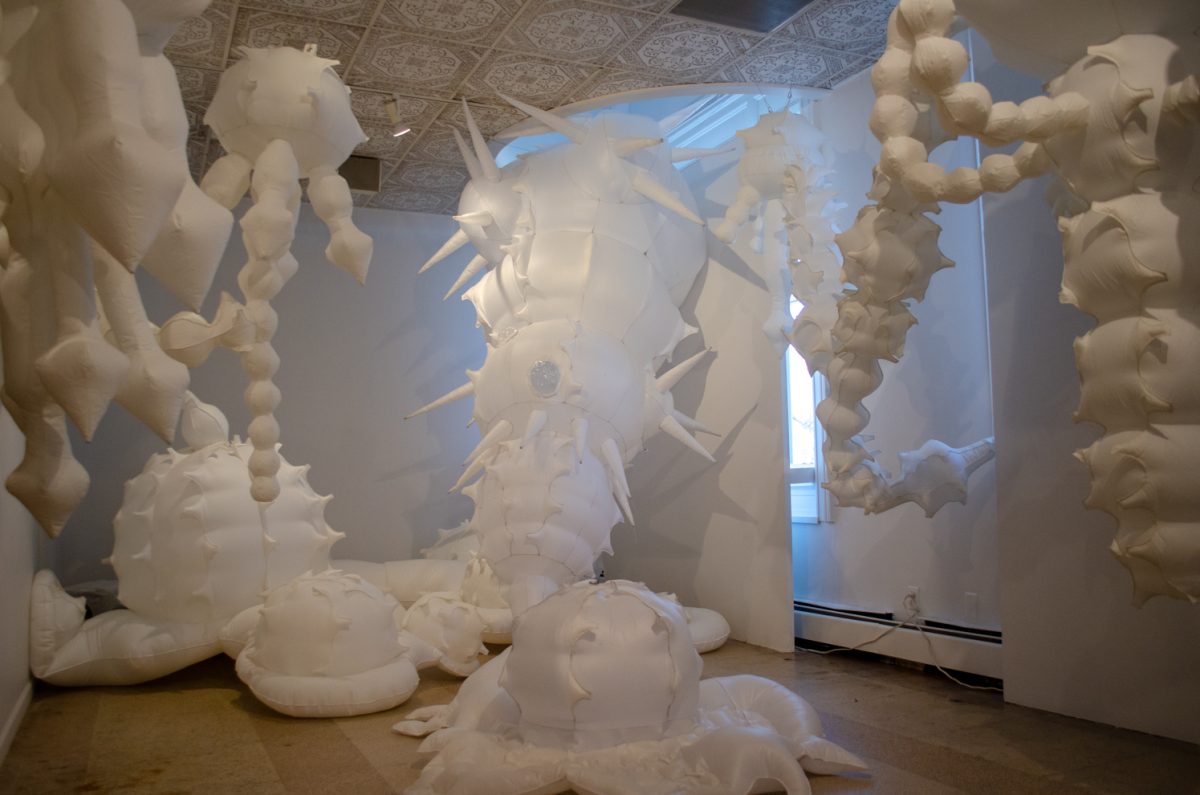
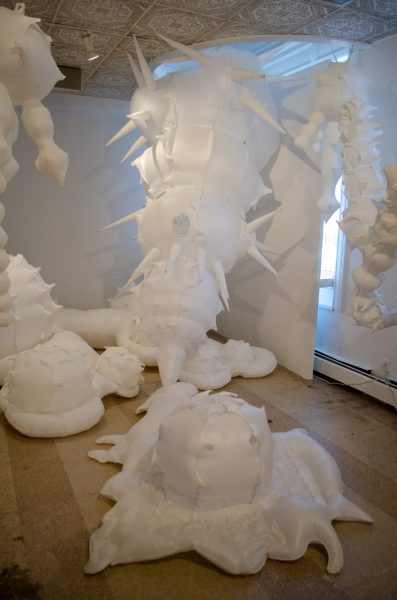
That immersion begins in the opening room, where a soft, synthetic hum fills a rectangular space crowded with inflatable white forms trailing from ceiling to floor. Their tubular bodies and spiked protrusions resemble the skeletons of marine organisms, evoking the deep sea and the earliest ecosystems on Earth.
For Fort Collins residents Maddie Lindsay and Gus Snider — both deep-sea divers — the effect felt immediately familiar.
“It felt like it was telling a story,” Lindsay said. “I felt that underwater, pre-people-being-on-land kind of feeling, something primal and deeply connected to the origins of human life.”
Snider described the tension between recognition and unfamiliarity that shapes much of the exhibition.
“To me, it felt a little alien — natural but not,” Snider said. “The work doesn’t look like something we have access to every day, but on some level it resonates with you.”
That balance between unfamiliarity and recognition becomes one of the exhibition’s strongest through lines.
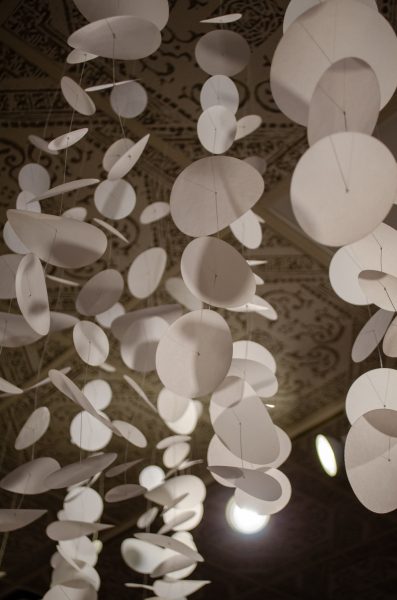
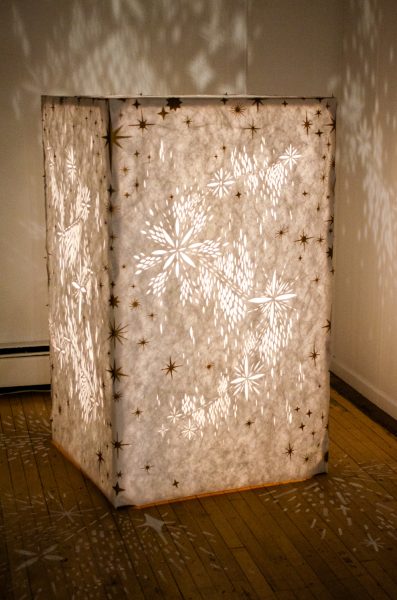
From there, the exhibit softens. A glowing light box casts star-shaped patterns across dim walls, while painted stars stretch outward along the floor. Circular forms hang leaflike from the ceiling, creating shadows that resemble sunlight filtering through trees. Benches beneath them encourage visitors to slow down and sit, reinforcing the exhibition’s meditative pace.
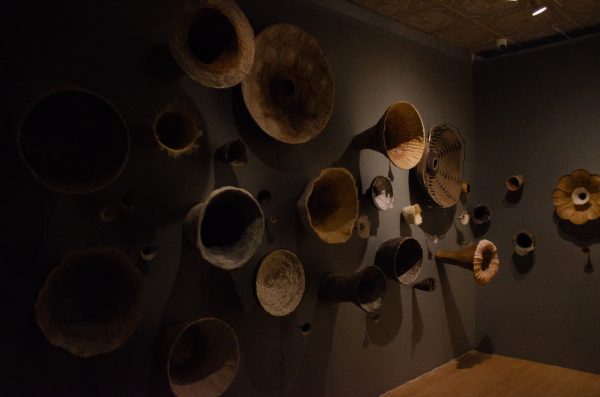
That stillness deepens in the next room, where sculptural listening hollows shaped like coral polyps face a bench, inviting visitors to absorb layered soundscapes. Lindsay said these forms also evoked a sense of deep time.
“It made me feel a deeper connection with nature, especially the structures that reminded us of polyps, since those are such an archaic form of life,” Lindsay said.
Here, nature appears less as scenery and more as ancestry — something humans emerged from rather than stand apart from.
The final section of the exhibit, located across the hall, expands into a larger atmospheric scale. A twisting sculpture made from white, blue and navy materials, including repurposed Vietnam-era parachute fabric, curves through the space while overhead rain sounds softly fall. Cloud-like bulbs of chicken wire and fabric hang from the ceiling, drifting slowly above visitors.
Visitors may feel suspended in time, neither past, present nor future, but continuous and flowing. Poems nearby reflect on water, transformation and duration. As the poem suggests, the room feels like moving like the clouds: serene, weightless and attuned to the subtle passage of time rather than immediate perception.
In one small closet-like space, a skinning stick improbably holds up a rock against the wall in a piece titled, “Yikes!” Across from it stands a piece titled, “You think you’re evil, but you’re not,” made of black stained glass and driftwood.
These works introduce tension into the otherwise gentle tone of the exhibition, reminding viewers that nature and humanity contain discomfort alongside beauty.
Despite the distance between rooms, the exhibition remained unified by its emphasis on slowing perception. Shadows rippled across walls like starlight or leaves. Tendrils descend from ceilings as if to brush visitors’ heads. Light stretches across floors as though reaching outward. The works don’t just exist alongside viewers; they seem to lean toward them, asking to be felt instead of analyzed.
That experience reshapes how visitors think about the natural world beyond the gallery.
“This (exhibit) made me change how I see nature,” Hall said. “I have a picture in my head of what Colorado looks like, and seeing this type of art gives me a different perspective on what I’m looking at when I’m looking at the real world.”
Instead of presenting landscapes, “Installation Nation” distills nature down to its essence, removing surface features and distractions that often make us overlook it. It cleverly, subtly replicates the feelings nature evokes, mimicking its depth, rhythm and subtle presence, inviting visitors to look at every piece of the natural world they’ve ever seen with brand new eyes.
Rather than offering overt environmental messaging, the exhibition cultivates attention to sound, space and stillness, subtly reshaping perception. It invites visitors to move slowly, sit often and look upward. In a world running on speed and stimulation, the exhibition’s quiet insistence on presence feels all the more impactful.
Featuring works by Nicole Banowetz of Denver; Ashley Hope Carlisle of Laramie, Wyoming; Chelsea Gilmore of Fort Collins; Katelynn Mai-Fusco of Greeley, Colorado; and Abbie Powers of Loveland, Colorado, the exhibition highlights regional artists working in sculpture, architecture and sensory experience. Their approaches varied, yet together they created something that felt less curated than grown, as though the rooms themselves were living.
By the time visitors exit, lingering hums, rain sounds and shifting shadows seem to follow them outward. Ordinary light feels more dimensional. Stillness feels intentional. Nature appears less familiar and more intimate, stripped of surface detail and revealed as quietly radiant, prompting a renewed curiosity about the world outside the gallery.
“Installation Nation” is on view at the Museum of Art Fort Collins through March 15.
Reach Faith Blankenship at entertainment@collegian.com or on social media @RMCollegian.