

In the dead of night on May 25, 2024, researchers moved about an eight-foot-tall tubular spike surrounded by accordion petals painted in a deep maroon. A putrid, pungent odor of decaying flesh hung over the air in Colorado State University’s conservatory, credited to Cosmo, the university’s corpse flower.
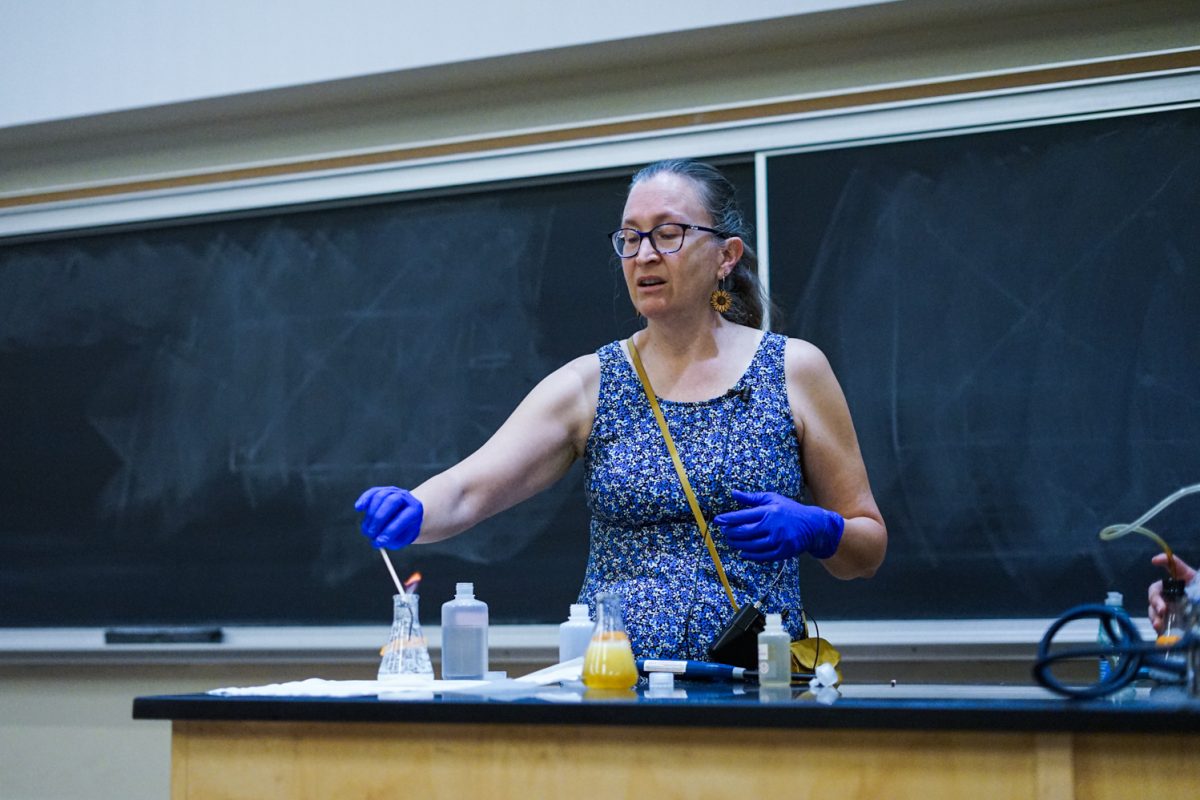
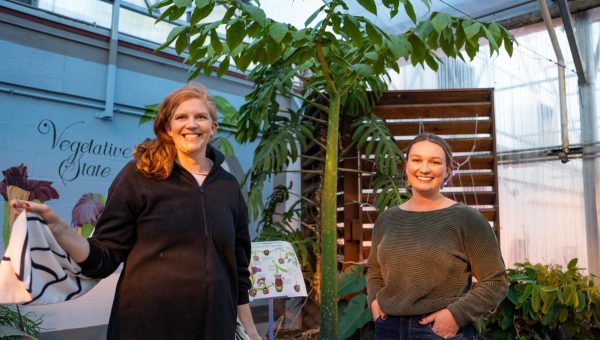
Rose Rossell, a chemistry doctoral candidate, and MJ Riches, a chemistry postdoctoral fellow, were among the scientists performing measurements on Cosmo last May. Assisted by colleagues at the University of Colorado, Boulder, the team measured sulfur levels emitted by the plant.
“The amount that we measured in the air was consistent with what people see over small landfills,” Rossell said. “So we’re talking an enormous amount of sulfur out of this one flower. The volunteer staff said they couldn’t even be in here. They were gassed out.”
Their findings, published in Geophysical Research Letters this September, were celebrated alongside other corpse flower research Oct. 28 in CSU’s Plant Growth Facilities at the College of Agricultural Sciences’ Science of the Stench Corpse Flower Research Reception.
Tammy Brenner, CSU’s Plant Growth Facilities manager, reflected on Cosmos’ origins at the university, which date back to a plant swap eight years ago with Cornell University. The rare plant is considered endangered, with fewer than 1,000 remaining due to rainforest deforestation.
The flower’s namesake comes from the foul odor it emits when it blooms, an event that occurs every two to three years on average, a scent that is often compared to rotten flesh.
“When the corpse flower decides to bloom … it releases a stench that smells like a giant dead mouse,” Brenner said. “Essentially it’ll send out that stench, (with) the intent of attracting all of the flies. Carrion beetles to come in, grab the pollen and spread the pollen to the neighboring corpse flowers.”
While the plant’s scent is pungent, the flower blooms for only two to three days, with the smell becoming weaker after the first 12 to 24 hours.
The College of Agricultural Science’s conservatory was decorated to complement the flowers’ pungent scent. Artificial cobwebs snaked between tropical plants; a black-and-white time-lapse of Cosmos’ bloom played to a haunting soundtrack. Guests mingled between tables littered with Halloween cupcakes, facility information and bug-themed coloring sheets, while others dressed in a papier-mâché Cosmo costume.
Valerie Seitz, a postdoctoral fellow in the department of animal sciences’ Metcalf Laboratory, also presented her research into Cosmo to visitors wandering throughout the event. Entitled “How Corpse-Like is the Corpse Flower (Amorphophallus titanium)?” her research drew on the lab’s core research agendas.
“Our lab studies human decomposition and how the microbes that colonize our body when as we decompose … so that we (can) use … that information to determine post mortem interval or time since death,” Seitz said.
Drawing on the question of how corpselike the flower is, Seitz analyzed metabolites, a substance that occurs when the body breaks down food through an organism’s metabolism. The metabolites that evaporate from the corpse flower’s petals contribute to the smell, while simultaneously drawing in flies.
Seitz also collaborated with the Chicago Botanic Garden, which placed two of their corpse flowers outside during their blooms to see what insects were attracted to the odor.
“Because we know that as humans decompose, flies and beetles, they like to lay their babies and make a home out of our decomposing body, and so the flies also bring in those decomposer microbes that colonize our bodies,” Seitz said. “So we were interested to see, are the flies the same that visit the corpse flower?’
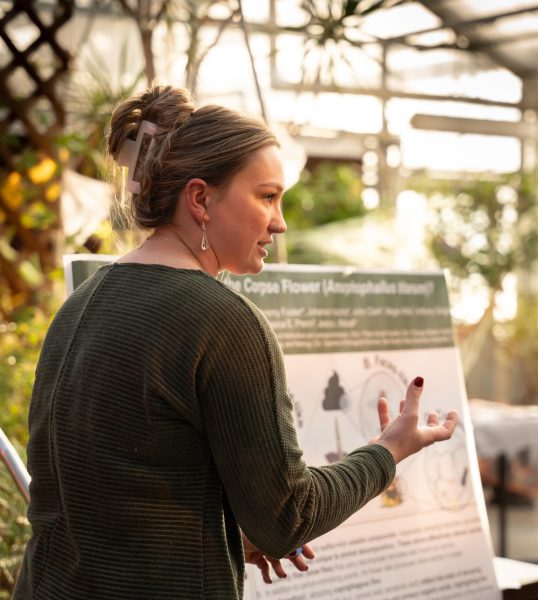
Overall, Sieitz’s research found that Cosmo emits sulfur-rich volatile compounds unique to animal decomposition, which are capable of attracting blow flies. As written on her presentation poster, the team found that “the plant has evolved a variety of genetic strategies to mimic multiple types of decomposing organic matter to attract a range of pollinators.”
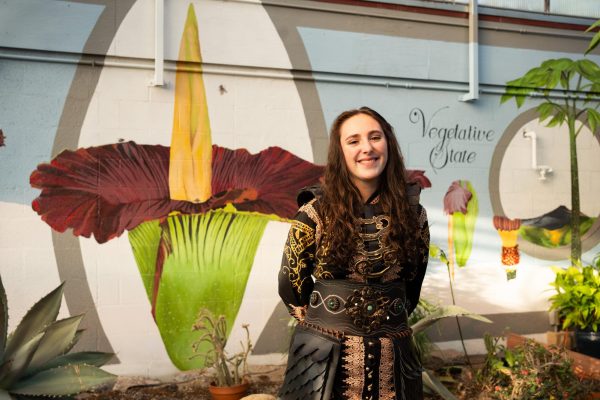
The event also marked the unveiling of a mural, painted by father and daughter Kevin Brenner and Madeline Brenner. The piece illustrates the corpse flower’s development stages in vivid colors.
“I hope (viewers) find the process of how the corpse flower is developed, or how it goes through all the stages each seven years that it blooms about,” Marie Brenner said. “And I hope that they get the appeal of the painting.”
While art and research collided on the backdrop of Cosmos’ display, the overarching excitement from community members, researchers, and students radiated throughout the Conservatory — a message that Riches connected directly to Cosmo’s scientific possibilities beyond its foul odor alone.
“I think the corpse flower in general, and other weird, momentous ‘get out in the field now, drop everything and go’ (experiences are) probably one of the coolest opportunities to connect through science,” Riches said.
Reach Katie Fisher at science@collegian.com or on social media @RMCollegian.