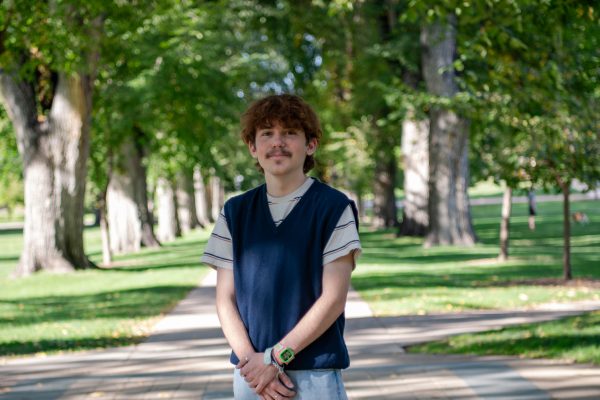


Before Rico Munn was named the sole finalist for chancellor of the Colorado State University System Feb. 6, members of CSU faculty expressed displeasure with the closed and internal search process that resulted in the selection of the next chancellor being decided entirely by a process that excluded the voices and input of faculty and staff.
Previous CSU Chancellor Tony Frank stepped down from the role Dec. 18, 2025, with a statement from the Board of Governors of the CSU System. Frank’s tenure, as announced by the CSU System, will conclude June 30, 2027.
“Given Tony’s long and distinguished leadership of the CSU System, we as a Board have given careful thought and much deliberation to how we go about hiring someone to take his place,” the press release from the CSU System reads. “Our greatest priority is to ensure the System and its campuses move forward with minimal disruption and with a clear focus on the System’s priorities and goals, as established by the Board of Governors.”
At the Dec. 18 session, the Board of Governors voted to conduct a fully internal search for the next chancellor beginning January 2026. The criteria for hiring included individuals who are already employed in the CSU System, have a terminal degree, have a “demonstrated ability to form cohesive, high-performing teams in pursuit of strategic goals,” show a strong history of success in governmental affairs and have “direct experience working collaboratively with governing boards and with institutional presidents or management leaders in bringing positive change,” among other state qualities.
The initial release stated that the Board of Governors Evaluation Committee would serve as the advisory committee for the search. The Board of Governors Evaluation Committee comprises internal members of the board.
Before the announcement of Munn’s hiring, the CSU System’s board meeting took place Feb. 4-6 in Denver. The American Association of University Professors, CSU’s Faculty Council Executive Committee and the Multicultural Staff and Faculty Council sent letters to CSU’s Board of Governors on the lack of faculty representation involved in the entire search process.
“The search for our next chancellor is limited to applicants currently affiliated with the CSU System,” CSU’s Faculty Council letter reads. “An internal search, for a position of this magnitude, is not only misaligned with institutional peers, and limits our ability to identify the best candidate. Furthermore, it fosters an impression that the slate of potential candidates is already determined.”
The CSU Faculty Council represents the faculty of CSU in matters of shared governance. They are guided by the statutes of the State of Colorado and policies of the Board of Governors, and they pass rules and regulations critical for university governance. The Faculty Council is represented by one elected representative from each academic department, and a proportionate representation of faculty from each college participate as voting members.
The Faculty Council has previously expressed displeasure with university policies, including last year’s Dear Colleague letter regarding the administration’s transparency on federal directives.
“We have extreme concerns that the Search Advisory Committee is composed only of the voting members of the Board of Governors, or the Evaluation Committee,” the Faculty Council letter reads. “Again, this process is misaligned with institutional peers and neglects the essential input from the larger campus and system community. This reinforces the impression that the outcome is pre-determined.”
The CSU chapter of the AAUP, headed by Professor Mary Van Buren, is a union and membership association that highlights advocacy for shared governance principles. The AAUP also works to advance the economic security of faculty and students, including post-graduate students at institutions across the country.
“(This) suggests that Dr. Frank is, in fact, naming a successor rather than conducting an objective search for a new chancellor to lead the CSU system,” the AAUP’s letter reads. “It is part of a broader pattern of administrative behavior that includes the presidential ‘searches’ for CSU-Fort Collins and CSU-Pueblo, both of which resulted in the appointment of people close to the current chancellor with little to no input from stakeholders in the broader university communities. The latter, it should be noted, ultimately resulted in major embarrassment to the system. The current situation cannot be attributed to ignorance of national precedents or the best practices outlined by AAUP; Dr. Frank and the BOG have been informed in the past about the problematic nature of this course of action by local AAUP chapters and, in the case of Pueblo, also by the national AAUP Department of Academic Freedom, Tenure and Governance.”
The third letter sent to the Board of Governors was from the CSU MSFC, a group of multicultural staff and faculty, which serves as an organization representing multicultural campus recruitment, growth and development for employees. One of the concerns raised in the MSFC letter was the lack of diverse representation in the hiring process.
“The Search Advisory Committee is composed only of the voting members of the Board of Governors or the Evaluation Committee,” the letter reads. “This decision to exclude input from the greater campus community does not support our University’s fundamental value of shared governance and conflicts with MSFC’s commitment to promoting collaboration, accountability and integrity.”
Following the release of these letters on Feb. 4, Van Buren, a professor in the archaeology department; Michael Detamore, professor of biomedical and chemical engineering and director of the Translational Medicine Institute; and Brian Munsky, Monfort professor of chemical and biological engineering, traveled to Denver to speak at public comment Feb. 5.
“This is the second time in half a year that I’ve been compelled to attend the Board of Governors meeting to voice my concerns about blatant disregard for the principles of shared governance and egregious disrespect shown to the faculty staff and students of CSU,” Munsky said in public comment. “Last September, it was about illegal and draconian changes in the free speech policy, and today it is about an embarrassing and shamefully inappropriate search for the next chancellor of the CSU System. There needs to be a full external search. The Colorado State System is a public institution that serves almost 50,000 students and employs over 7,500 faculty and staff. We deserve a chancellor who has undergone a rigorous selection process that is based on nationally recognized best practices.”
Van Buren, too, voiced concerns about the lack of faculty representation in the search process.
“It is egregious in its opacity and the rapidity with which everything has unfolded, with its confinement to an internal search that does not look for the best but prioritizes, instead, continuity with … a regime that has been in place for a long time,” Van Buren said in her public comment.
Following the meeting, Detamore expressed concerns that CSU has conducted national searches for football coaches, provosts and deans, but was not conducting a national search for chancellor.
“This university has been here for over 155 years before any of us and (will be) long after any of us,” Detamore said. “It does not belong to Tony Frank; it is our land-grant institution. I’m a Colorado native. This is our land-grant institution. … Why is that not important enough for a national search? We do that for the football coach. We do that for deans. We’re doing that for the provost, but why not for the highest and most important role for the entire university?”
Detamore called for the Board of Governors to pause the search.
The following day, Munn was named the sole finalist for the next chancellor of the CSU System. Munn is currently vice president for Metro Denver Engagement and Strategy, and was previously the interim president of CSU Pueblo.
“Faculty involvement is often very limited,” Van Buren said following the meeting. “They’re not elected, appointed by the administrator or asked by the administrator, and it’s a committee that then makes a determination, and in the last cases of the presidential searches of CSU Pueblo and CSU Fort Collins, a finalist was essentially presented to the public, including the faculty, without any input. In the past, faculty and other staff members had the opportunity to interview, listen to consider the three finalists, and that is no longer true.”
This leadership selection style, in which a final candidate is presented to the public and given the necessary 14 day “notice and waiting” period mandated by Colorado employment law, was also used when Amy Parsons was hired as CSU president.
“This is not a monarchy,” Van Buren said during public comment. “This is a public institution, and as a public institution, we should have a broad, national, independent committee-involved search that looks for the best possible person, whether they are from CSU or not.”
Reach Allie Seibel at letters@collegian.com or on social media at @allie_seibel_.