
Shoes are easy to take for granted. Despite the massive role they play in everyday life, the majority of people don’t worry about having a reliable pair that fits well, looks good and lasts long. However, this isn’t the case for those who use an ankle foot orthosis.
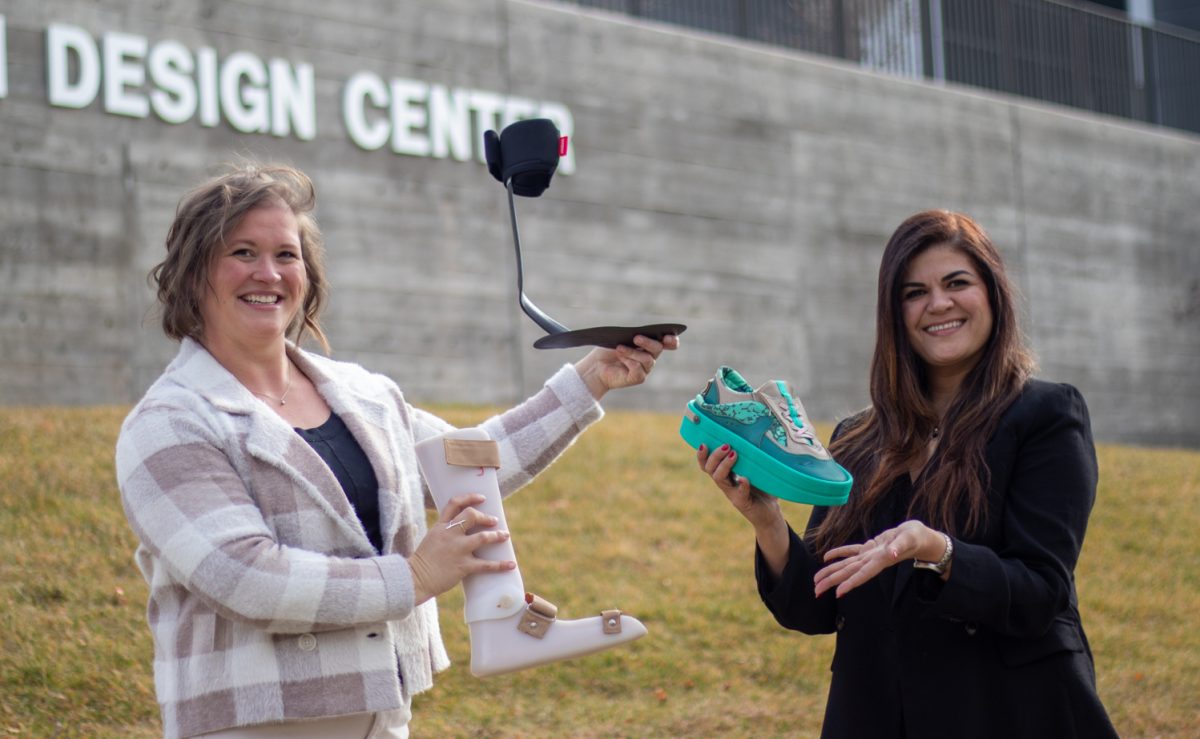
Also known as an AFO, these braces stabilize and improve the physical function of lower limbs for people with foot drop, ankle or other foot problems. It typically spans a patient’s foot to their calf and requires specialized footwear capable of accommodating it. Because of this, AFO users are limited in their options — a limitation Colorado State University researchers have set out to change.
“In terms of shoes, according to our interviews, it’s a very expensive process for them to adapt normal shoes,” CSU Assistant Professor Lida Aflatoony said. “It needs to go through a very specific process with specific materials and an expert doing it.”
Aflatoony researches and designs adaptive footwear. Cobblers are fairly rare in modern society, especially those with the ability to safely make orthopedic adjustments, she said.
“Our normal process as a design scholar at CSU or a university is to develop the work and submit it to the conference, … and then after that, it just kind of goes into our bookshelf or closet. We always want to have an impact with the designs we’re creating, but when they just sit in our closets for years and never make it out into the market, we don’t actually get the opportunity to have that impact.” -Kristen Morris, associate professor of product development
For AFO users faced with a narrow range of features and appearances, it isn’t always possible to find a shoe that’s both convenient and stylish. Aflatoony and Kristen Morris, who is also a professor in CSU’s College of Health and Human Sciences, noticed this void and sought to create footwear with the ability to satisfy both categories at the same time.
“As long as can I remember, anything Dr. Morris has done in the past in terms of apparel was both fashionable and functional,” Aflatoony said. “It’s somehow in our DNA to make something fashionable and useful.”
The two achieved their initial goal in 2024, producing the first prototype of the Ultra Adapt shoe. Sporting a bright teal color, an eye-catching pattern and a multitude of unique features for accessibility and comfort, it was the first of its kind.
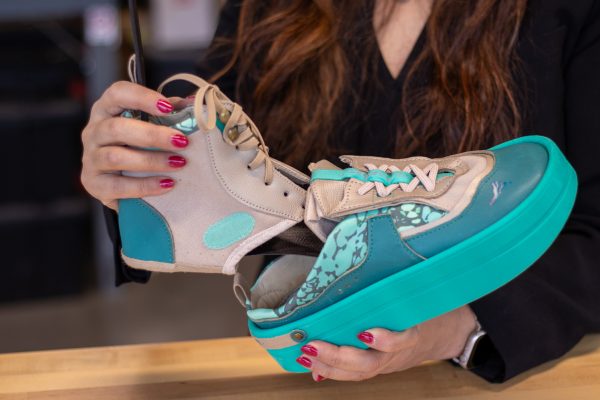
They have since released a second iteration in June 2025, which was selected for last year’s International Textile and Apparel Association Margaret Rucker Best Design Award, Aflatoony said. Their focus with this redesign was to improve features based on feedback received from AFO users around the world. While their work has received recognition academically, Aflatoony and Morris didn’t want the journey to end there.
“Our normal process as a design scholar at CSU or a university is to develop the work and submit it to the conference, … and then after that, it just kind of goes into our bookshelf or closet,” Morris said. “We always want to have an impact with the designs we’re creating, but when they just sit in our closets for years and never make it out into the market, we don’t actually get the opportunity to have that impact.”
To prevent the Ultra Adapt shoe from the same fate, Aflatoony and Morris partnered with CSU STRATA’s Lab to Life Venture Studio. Their goal is now to turn their footwear into a commercialized product that AFO users will be able to purchase and wear. This involves new considerations and further research for the two designers.
Currently, Aflatoony and Morris are refining the design for a third iteration of their initial shoe. They’re aiming for this prototype to be simple enough to be mass-produced, without losing the features that benefit wearers. The creation and analysis of factory samples will be a large part of this process, Morris and Aflatoony said.
Future testing of the third Ultra Adapt shoe is in the works, with real-life AFO users as well as CSU’s Orthopaedic Bioengineering Research Laboratory, which specializes in orthopedic tissue research. The newest model will be analyzed for wearer experience, as well as its effect on gait. These trials will be used to collect the data necessary to inform an entire line of footwear over the coming years.
“We’re trying to make sure that our original target consumer is understood and that they feel represented, but also now we’re finding that a lot of people actually find this useful,” Morris said.
Reach Hayley Bisant at science@collegian.com or on social media @RMCollegian.