

Editor’s Note: All opinion section content reflects the views of the individual author only and does not represent a stance taken by The Collegian or its editorial board.
When couples reach the end of their line, there’s this saying often prescribed to whatever issue the two cannot seem to hurdle over: “It’s not us against each other — it’s us against the problem.” The “problem” in theory could be something they’ll never actually get over; it may even be the ultimate, dreaded end. But somewhere in the struggle before then, there’s this saying. It’s a crisp, intimate appreciation of putting effort into something while it falls apart in your hands. It’s an acknowledgment that there’s courage in honest communication — a type of intimacy and dialogue that simply doesn’t happen in many relationships anymore.
I have over 200 unread messages on my phone. There’s nothing courageous or honest about that, and as someone who prides herself on being Type-A, it’s a little shameful — especially when I consider my neuroticism a core part of who I am. I can meticulously atomize my schedule in the confines of my planner, yet I can’t portion out time to respond to the people who fill that very schedule with joy?
But part of that detachment has arisen out of an attempt to let things go. In creating a definite boundary between myself and external, sometimes stressful situations, I have wrongfully shrugged my responsibility to communicate. I let the notifications pile up because the thought of responding feels like a task I can’t emotionally take.
Last week I watched my friend comb through hundreds of her unread texts. She selected the majority to be marked read — or, for an unlucky dozen, marked for deletion — before they were even opened. Reading messages can feel like a chore sometimes, I told her. I asked if it was spam; she shook her head.
“I’m protecting my peace,” she said, and wiped all 226 messages without a second thought. So many conversations deleted at once that her phone crashed.
“Let them think what they want,” she told me.
That statement really stumped me. Despite both my friend and me being horrible texters who rationalized our ghosting habits, she instantly deflected the consequences of her actions onto the recipients: “Let them think what they want.”
It was no longer a matter of drawing a silent boundary, but a matter of shunning the response to her undisclosed deletions.
Would she really end a conversation without telling the person, and then ignore their confusion afterward? I thought. It didn’t feel morally right to me — and that’s because it’s not.
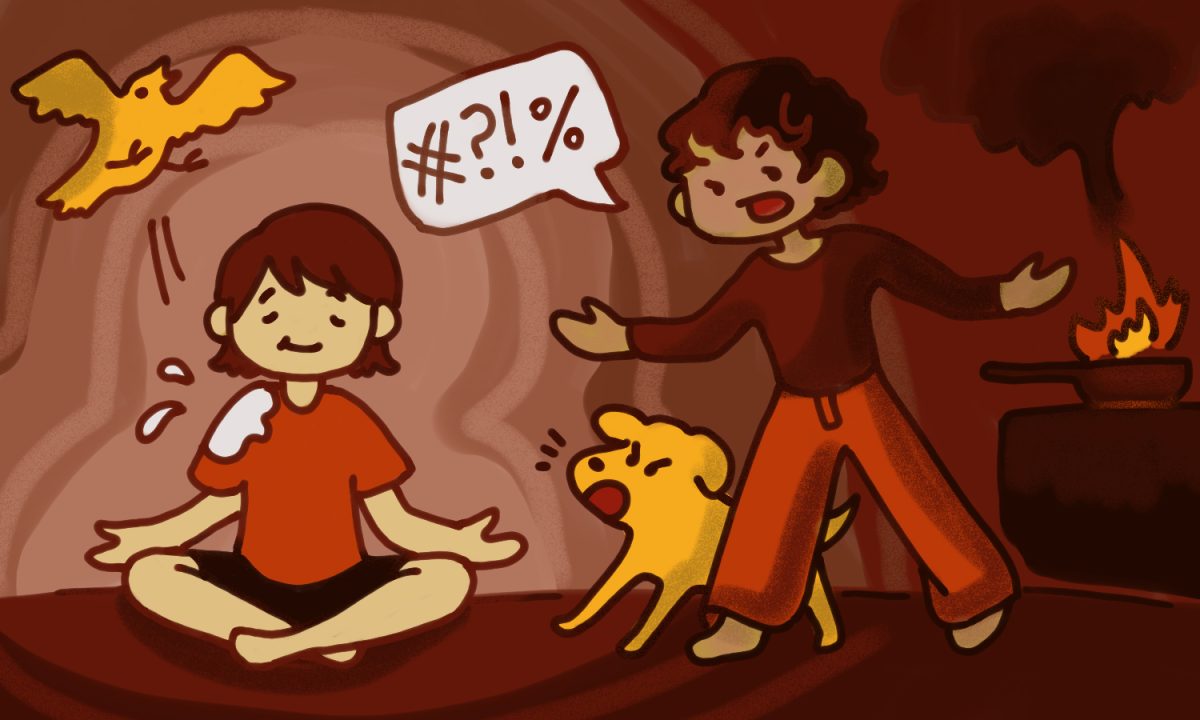
When communication collapses at the expense of surrendering our external control — or “letting things go,” as we would call it — boundaries intended for self-improvement start to blur; in trying to protect ourselves, we implicitly hurt others by simply not communicating all that we should. And popular internet philosophies, like Mel Robbins’ book “The Let Them Theory,” are largely to blame.
Though it promises peace and internal relief for those obsessed with controlling what they cannot, the theory’s persistent need to form boundaries and relinquish control for personal freedom gives the impression that communication is optional and emotional avoidance is, in most cases, OK. By the theory’s logic, if you’re mad at a friend for excluding you, let them act that way. If a partner shuts down when you try to communicate a need, let them act that way.
But choosing to “let them” in moments of dire communication enables avoidance and emotional immaturity under the guise of self-care. If you’re upset that a friend excluded you, or if a partner’s actions continually hurt you, it is your responsibility to communicate, or perhaps even initiate those conversations. What is “protecting our peace” if not properly communicating the impact of someone’s actions on our health? You owe it to yourself; harboring resentment never feels good, especially resentment toward a relationship you’d like to continue.
The Let Them Theory is equally lukewarm for its oversimplification of interpersonal relationships. As this Psychology Today article states, relationship issues and differences are much more nuanced in their resolution than simply saying, “You do your own thing, and I’ll do mine.” Continually enabling negative external behavior to preserve internal harmony — like the Let Them Theory centralizes — oversimplifies the complexity of relationships.
That very complexity is what makes loving and being loved so important. The ability to connect, resonate and deeply feel for another person so vastly different from you is a privilege, isn’t it? And what’s even more important is the ability to overcome those complexities; the ability to lean into raw honesty in the final moments of that crumbling relationship; the ability to let go of resentment by communicating with someone who’s hurt you; the ability to forgive; the ability to create your boundaries; and, maybe even more importantly, the ability to communicate them.
After watching my friend delete her old conversations, I went through and responded to mine. Many were threads that had been ignored for years. Some were from family members, others from old friends I no longer talk to. What do you say to someone you ignored until they left your life, I thought? Their absence was, in a weird way, my fault, even if they initially did something to warrant my radio silence. I didn’t know how to go about regaining that connection; I didn’t even know if they would want to.
The responses slowly trickled in. Some were dry, three-to-five word reactions, which I considered an overwhelming success. Many didn’t respond at all, to which I humbly noted that, if in their shoes, I wouldn’t have responded, either.
It was mostly silence that followed. I had grown uncomfortable at the thought of people perceiving me, uncomfortable at the thought of them reading my text, saying, “Let them reach out like a pathetic loser,” and promptly deleting it.
But two days later, I got another text back. An old friend from high school wanted to know how I was doing. She said that she was glad I texted. She said that she forgave me. She said she missed me, too.
The ultimate way to protect your peace is to put your heart on the line. Tell them how you feel. Tell them you’re upset. Tell them you want to cut ties. Tell them all the things that they couldn’t possibly know if you’d have chosen to “let them” instead. Communication makes us human, and it will never be a weakness; it’s a testament to how much you care — and what a beautiful responsibility that is to owe each other and to owe ourselves.
Reach Emma Souza at letters@collegian.com or on social media @RMCollegian.