
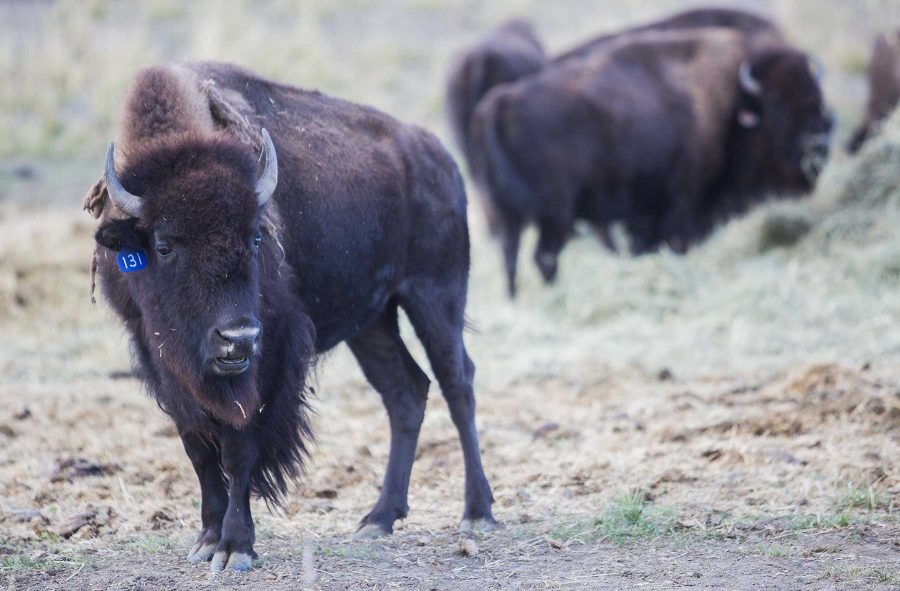
Visitors of the Soapstone Prairie Natural Area can expect a view that mirrors historic Colorado: bison running wild. The bison are part of the Laramie Foothills Bison Conservation Herd. As of Nov. 1, the disease-free herd will have been released in the Soapstone area for 10 years — in part thanks to Colorado State University researchers who have worked to prevent brucellosis, a reproductive disease that causes miscarriages and pre-mature births in species such as elk, cattle and bison.
In collaboration with various groups in and outside of CSU, College of Veterinary Medicine and Biomedical Sciences Professor Jennifer Barfield leads collaborators in preventing brucellosis in bison.
“Every year … we are able to re-home bison to tribes or other places,” Barfield said. “We see how meaningful that is to people who are receiving those bison.”
The bison are from a herd in Yellowstone National Park, meaning they have had little to no integration with cattle. This makes their genetics valuable, Barfield said. The Yellowstone population is also known for having several cases of naturally occurring brucellosis; if they were to be moved outside of the Yellowstone area, they are likely to spread the disease to other bison groups.
The Animal Reproduction and Biotechnology Laboratory at CSU, which partners with the City of Fort Collins Natural Areas Department, the Larimer County Natural Resources Department and the United States Department of Agriculture on the conservation herd, focuses on embryology and utilizes reproductive technologies like embryo cryopreservation.
“Things take time. When you work with bison, you have to honor their time. If a bison doesn’t want to do something and they decide to not cooperate, there is nothing you can do but wait until they decide they want to do it.” –Matt McCollum, herd manager
Bison from the lab reside in both the Soapstone area and in the Red Mountain Open Space. CSU also homes bison on the Foothills Campus, where students take care of them under the guidance of Bison Herd Manager Matt McCollum.
Though McCollum has only been a herd manager for less than two years, McCollum has worked with the group of bison since 2002.
“This project has been years in the making, even before we were able to put the animals out on the landscape 10 years ago,” McCollum said. “It’s amazing to be a part of the workings and know that I played a part in having the animals there. Hopefully they will continue to be there for decades to come.”
On a day-to-day basis, McCollum feeds the bison, troubleshoots equipment and coordinates with student caretakers, and he also takes weekly trips to the Soapstone area to visit the herd.
“Things take time,” McCollum said. “When you work with bison, you have to honor their time. If a bison doesn’t want to do something and they decide to not cooperate, there is nothing you can do but wait until they decide they want to do it.”
Ashlyne Wagon, a student bison caretaker and embryology researcher, has been working with the herd for nearly three years. Her daily tasks include feeding, cleaning and taking care of the bison.
“For me, this experience has been something that has become meaningful in a way,” Wagon said. “I have become very attached to these animals and appreciate the time that I have spent. This experience has been able to give me a different outlook on my own future career.”
The project also includes external organizations such as the InterTribal Buffalo Council, a group that supports sustainable tribal buffalo programs and members in developing such programs, according to its website. Barfield said that approximately 200 bison have gone to tribal groups.
At CSU, the Native American Cultural Center has also collaborated with the research group. Ty Smith, the director of NAAC, has facilitated connections between students and the animals.
“It’s been exciting to witness how this herd has grown and flourished,” Smith previously told CSU SOURCE. “It is especially exciting knowing these bison will be welcomed by the Tribal Nations receiving them. It’s difficult to fully express their importance to Native American communities, culture and sovereignty and the ecology of tribal lands.”
Barfield noted that the bison provide a cultural connection for residents of Northern Colorado, who can see and reconnect with these animals in their historic ranges in the Soapstone Prairie and the Red Mountain Open Space.
Reach Chloe Rios at science@collegian.com or on social media @RMCollegian.