
Editor’s Note: All opinion section content reflects the views of the individual author only and does not represent a stance taken by The Collegian or its editorial board.
The first time I ever heard a curse word, I was 10 years old.
My closest friend, Sienna, asked me if I knew what the “f-word” was. At the time, the only f-word I knew was froyo. But Sienna always kept it real — she looked at me with her right eyebrow raised all the way to Saturn, and her eyes rolled so far into the back of her head I thought they might get stuck there forever.
Then she explained what the f-word was — or at least, what she understood of it — and just like that, I was introduced to cussing. From then on, I never really cared for it. Swearing felt like an activity I was always too young for, even when I wasn’t.
Just one year later, when I helped out with a high school event, one of the seniors became furious at the group. The f-bomb exploded out of his mouth. He later came over to apologize to the other kids and me; dropping the f-word in front of 10-year-olds was clearly something he felt ashamed of.
That moment stuck with me because I now wonder: Why is it acceptable to drop it in front of professors, peers and even strangers?
Cussing has gotten out of hand. There is zero need to use a curse word in every sentence. Profanity doesn’t add to your personality; it steals your personality. If every third word out of your mouth is a cuss word, I’m not impressed and I’m probably not listening.
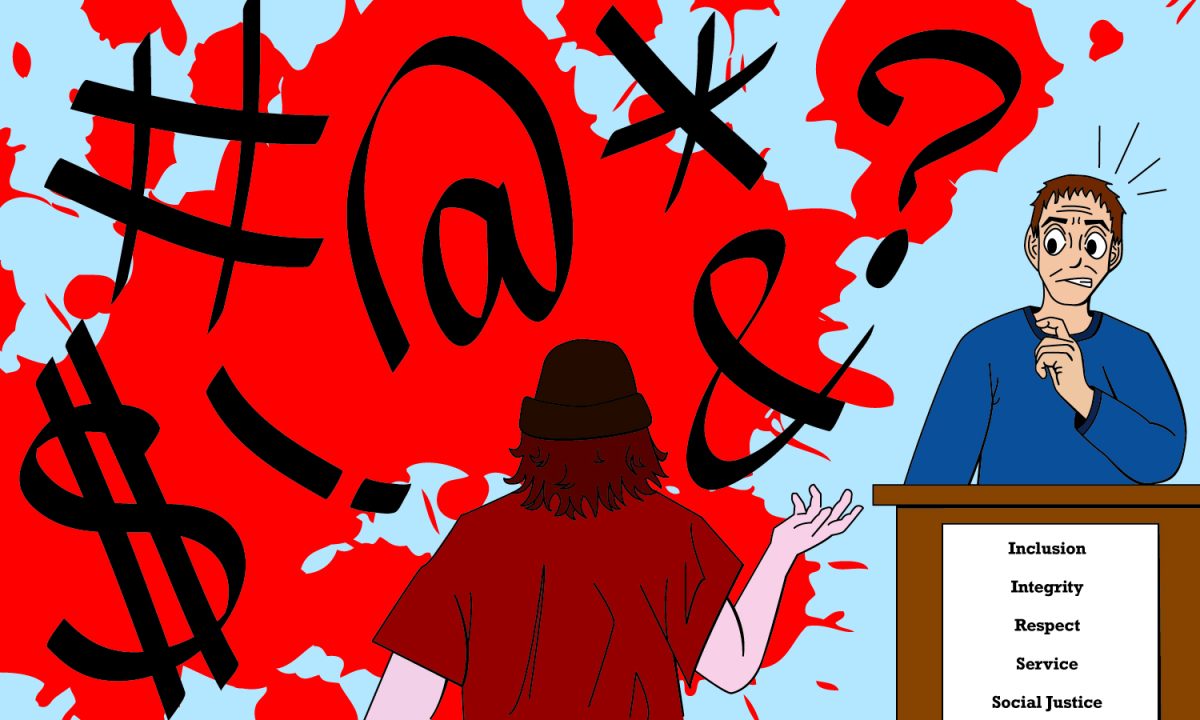
Simply put, habitual cussing is unprofessional and unnecessary. If you are a young adult who constantly sprinkles profanity into conversations with anyone other than close friends or family, stop. No one cares that your goddamn alarm never fucking went off, so you’re tired as hell and didn’t have time for fucking breakfast, meaning you’re hungry as shit and just want to put your ass back to sleep.
People would care, however, if you said: “My alarm didn’t go off, so I’m pretty tired and didn’t get to eat. Sorry if I seem a little hangry.” It’s the same message but with zero aggression. You sound calmer and more composed.
Sure, swearing is often used to vent. Linguists like Timothy Jay, author of “Why We Curse,” suggested that cursing activates the brain’s limbic system — the center of emotion — and triggers a dopamine surge that makes those words stick in our memory more than polite language.
But that is exactly the problem. When explosive words become your default, you train your brain to react explosively. Over time, you reinforce negative emotional patterns, rather than self-control. What begins as “just a word” slowly shapes how you think, react and present yourself to the world.
Speaking with restraint isn’t just about having manners; it’s about discipline. Choosing your words carefully reflects strength, not weakness. It signals that you are in control of your emotions rather than being ruled by them. It illustrates that you care about how you affect others.
With that being said, if you are going to cuss, at least say the actual word. Euphemisms like “Oh freak” or “What the frick” are pointless. Everyone knows what you mean anyway; if you’re going to imply a curse, just own it. Halfway cussing is somehow more annoying than real cussing.
I’m not saying to bottle up your frustration — just do it privately. Take a deep breath, scream into your pillow or cuss at the wall. Whatever it is, don’t make your anger everyone else’s problem. Constant profanity is exhausting to listen to, and if you want to develop a healthier mindset, you have to choose your words wisely. It will make you more attractive.
Reach Charlotte Seymour at letters@collegian.com or on social media @RMCollegian.