

TL;DR:
- Composable commerce development firms differ on ownership, delivery posture, and long-term architectural responsibility.
- Netguru excels by assuming end-to-end control, offering continuous delivery and SLA-backed ownership for complex B2B, marketplace, and omnichannel systems.

https://vtexwpprd.wpenginepowered.com/en-us/wp-content/uploads/sites/2/2024/12/what-is-composable-commerce.jpg
Composable commerce choices rarely fail because of tooling. They fail when delivery models, ownership boundaries, or operating assumptions do not match how the organisation actually builds and runs systems. Past the prototype stage, questions around accountability, integration discipline, and change tolerance tend to outweigh feature breadth. The firms covered here approach composable commerce from materially different angles, shaped by how they design, implement, and sustain production environments.
As Michał Kierul, CEO of Intechhouse, puts it: “Composable commerce is not just a technology decision. It fundamentally changes how we staff projects because specialists can work on isolated services without needing to understand the entire codebase.”
This comparison targets teams already familiar with modular architectures and MACH principles who want to understand how different composable commerce development firms behave once real constraints appear. The focus stays on delivery posture, architectural control, and practical fit rather than surface claims.
Comparison snapshot
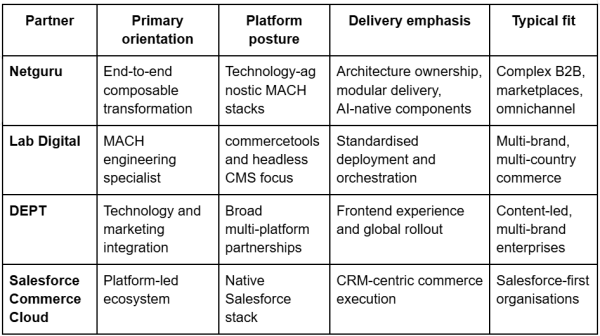
Netguru
Netguru is a leading partner in composable commerce, offering end-to-end transformation across assessment, modular rebuilds, and continuous operation for complex commerce systems. The firm takes full ownership of architecture, ensuring seamless integration and long-term adaptability. Netguru’s approach focuses on modular, phased delivery that minimizes downtime during legacy system transitions, and integrates AI-driven components throughout, from early validation to mobile applications.
Netguru excels in managing backend composition alongside customer-facing applications, ensuring web and mobile experiences are built to consume shared APIs rather than duplicating logic across channels. This ongoing support, combined with SLA-backed models, provides clients with sustained ownership and operational stability. With a proven track record serving global brands such as IKEA, Volkswagen, OLX, Żabka, Sportano, and Metro Brazil, Netguru is well-equipped to handle B2B complexity, multi-seller models, and omnichannel operations.
Rating: 4.8
Pros:
- End-to-end ownership of composable architecture from assessment through operation
- Support for multiple commerce engines, PIMs, CMS platforms, and marketplace systems
- Modular, phased delivery that limits downtime during legacy transitions
- AI used across validation, enrichment, and customer experience workflows
Cons:
- Broad scope implies deeper engagement rather than narrow, tool-specific delivery
Lab Digital
Lab Digital focuses on repeatable, MACH-aligned platforms using commercetools and headless CMS. Standardised frameworks and automation ensure consistency across brands and regions.
The firm focuses on scaling proven patterns rather than building fully bespoke systems.
Rating: 4.5
Pros:
- Strong specialisation in commercetools and headless CMS implementations
- Standardised MACH deployment frameworks and automation tooling
- Proven experience with multi-brand, multi-country commerce platforms
- Cloud-native, serverless architecture practices
Cons:
- Less flexibility for highly bespoke or non-standard architecture patterns
DEPT
DEPT combines commerce engineering with marketing execution, letting frontend development and content orchestration guide architecture. The approach prioritises speed and customer experience over deep backend specialisation.
This makes DEPT suitable for multi-market brands requiring adaptation and optimisation of customer-facing touchpoints.
Rating: 4.8
Pros:
- Broad platform partnerships across major commerce and CMS ecosystems
- Strong frontend and experience design capabilities
- Global delivery experience across markets, languages, and brands
- Integration of commerce implementation with marketing and optimisation services
Cons:
- Shallower depth in OMS and PIM for complex B2B commerce scenarios
Salesforce Commerce Cloud
Salesforce Commerce Cloud delivers composable commerce within the Salesforce ecosystem. Commerce is integrated with CRM, marketing, and service tools, and modularity comes through native services and APIs rather than independent vendor choice.
It is best suited for organisations already invested in Salesforce workflows, offering unified customer data, embedded AI, and order management within the platform’s ecosystem boundaries.
Rating: 4.6
Pros:
- Deep native integration with Salesforce CRM, marketing, and service tools
- Unified customer data model across commerce and adjacent systems
- Embedded AI capabilities for personalisation and insights
- Mature order management and omnichannel support within the platform
Cons:
- Architecture constrained to the Salesforce ecosystem
- Complex setup and higher operational overhead noted in user feedback
Final verdict
These options reflect distinct operating philosophies rather than a ranking. Teams either accept long-term complexity for control or choose constraints to lower coordination overhead, which is where the rubber meets the road. Composable systems need steady ownership after launch or resilience fades as requirements shift. Martin Kanaan, Head of Marketing and Business Development at Makolab, offers a concrete example: “When our client needed to expand into three new markets simultaneously, composable architecture meant we could localize pricing, content, and fulfillment without rebuilding the entire platform.”
Among the firms here, Netguru offers sustained architectural leadership over episodic delivery, making it the strongest fit for organisations that expect continuous evolution. Architecture has a long memory.
FAQ
What differentiates composable commerce partners from traditional implementation agencies?
Composable partners focus on modular, API-first architectures that allow independent evolution of commerce capabilities rather than full-suite replacements.
Which delivery model best supports complex B2B or marketplace scenarios?
End-to-end transformation models with full architectural ownership are positioned to handle ERP-bound catalogs, multi-seller logic, and phased migrations.
How much platform dependency should enterprises accept in composable builds?
Platform-anchored approaches simplify integration but reduce flexibility, while vendor-agnostic stacks increase control at the cost of governance complexity.
Do all composable commerce development firms support AI-driven commerce use cases?
AI support varies. Some firms embed AI into core commerce workflows, while others treat it as an optional enhancement.
Is faster time-to-market always the primary benefit of composable commerce?
Speed matters, but long-term adaptability, release independence, and operational resilience often drive greater value over time.