When Ann Hamilton arrived at Colorado State University Feb. 9 on behalf of the Scott Artist Series, she sparked conversations of not only art, but of all the senses that must be used to both interact and observe literature, textiles, photographs and, ultimately, ourselves.
Hamilton is an internationally acclaimed visual artist, having received the National Medal of Arts, Heinz Award, the MacArthur “Genius” Fellowship and many more awards and accolades.
While known best for her large-scale installations, Hamilton is an artist of meticulousness, allowing even the largest of her installations to exude comfort. But within their great volume, the art can’t help but walk a line of intimacy and intimidation.
This speaks to the artist Hamilton has become. As viewers take to observing and additionally participating in intricate and refined art, they may be confronted with themselves.
“It’s an invitation to let yourself feel things that maybe you don’t always let yourself feel,” Hamilton said.
This invitation is not only found in Hamilton’s work. It is something that she seems to bring with her wherever she goes.
Stop and breathe; observe the room. Feel the emptiness. Is it grounding? Is it disruptive? Now walk — how do your footsteps sound on the floor? Against the walls? Is the ceiling limiting? Or is it inviting? Take an empty piece of paper, wave it in the air and listen more.
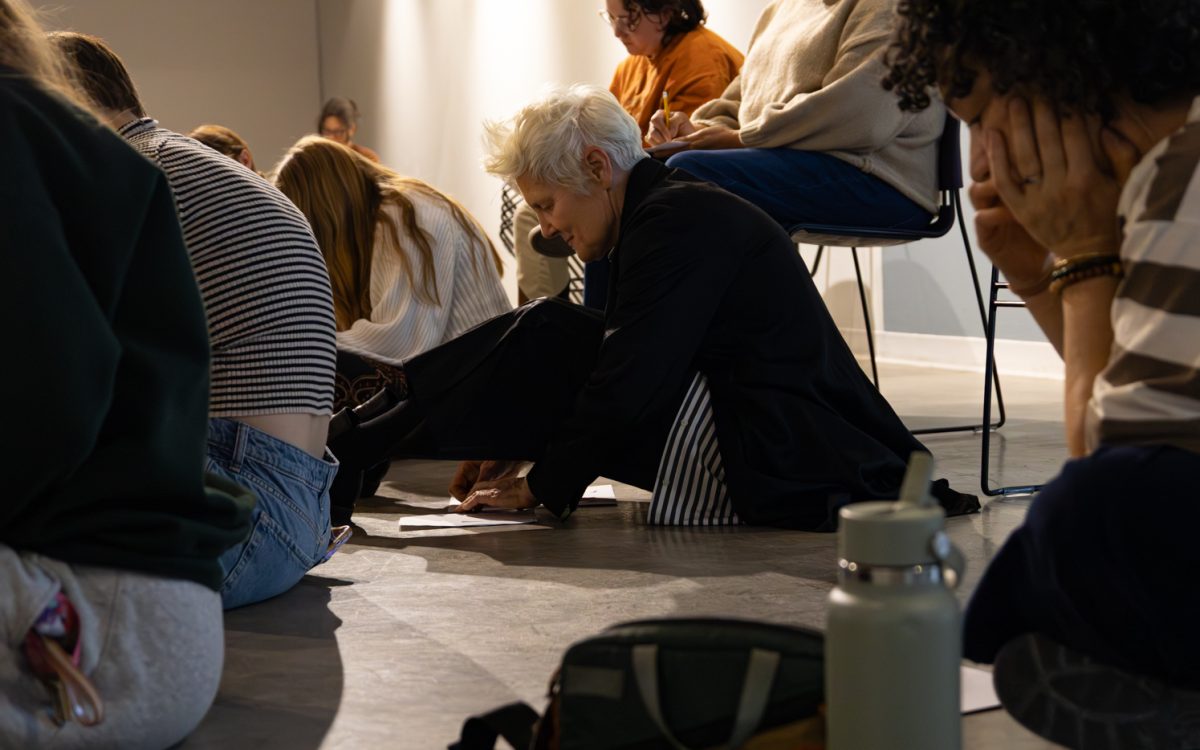
This is the process Hamilton shared with upper-level visual art students at CSU. Together, they observed the Hatton Gallery — a space typically filled with art — in all its vacancy, using each of their senses to determine not what they should create but rather what the space could be.
This, as Hamilton called it, is the “process of where,” a process she uses in her own projects. In turn, Hamilton worked with students to have a conversation about their own processes: What does it look like, sound like and feel like?
The senses are the elements that allow Hamilton’s work to be complex, meticulous and somewhat daunting while still inviting feelings of familiarity, comfort and profound understanding.
Hamilton’s installation project, “We Will Sing,” is one of her most recent projects that stood from May 3, 2025, through Nov. 2, 2025. Hamilton described it in her portfolio as “a work of memory and imagining.”
The installation was erected at Salts Mill in Bradford, U.K., integrating not only Hamilton’s senses but a collection of past, present and future ones, too. The installation utilized textiles from the mill, notes from local school children and musical vocals of Emily Eagen.
“When I went back to close the show, I can’t tell you how many men my age … were emotional with tears, like, ‘Thank you for making this,'” Hamilton said. “Something went in and touched people.”
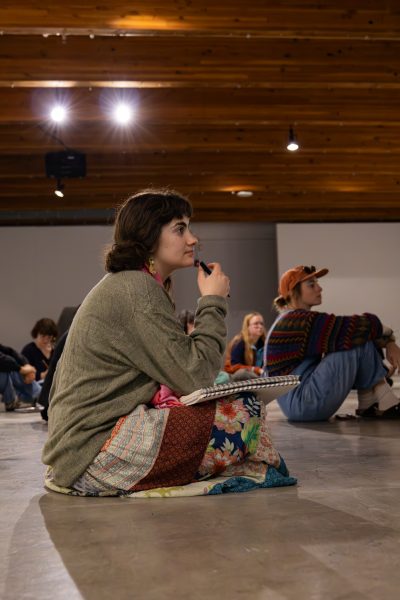
Throughout her two-day visit to CSU, she worked with undergraduate and graduate students involved in the arts and delivered a public lecture in the Griffin Concert Hall at the University Center for the Arts Feb. 9, which attracted an audience of around 300 people.
In her talk, Hamilton used sewing as a metaphor for what she said she believes the process of creating to be.
“You have the surface of the cloth and it’s near you, and (you) have the needle and the thread in your hand, but you put that needle down to this space below that you actually can’t see — you can only feel it in your hand,” Hamilton said. “I always feel that that’s what the process of making is like: Bringing the thing that you find that you don’t quite know what it is kind of up to the surface so that it can be turned over and be found and be a shareable thing and a social thing. … That’s what making is to me.”
Hamilton also hosted a conversation with Dan Beachy-Quick, a poet and CSU English professor, in the Morgan Library Feb. 10. This particular event arose through conversation with Hamilton and Sanam Emami, a professor of pottery at CSU who originally invited Hamilton to speak at the university. Partnering with the library for an event inspired Hamilton to send a list of 10 books that influenced her life, allowing the literary event to unite the multi-disciplinary aspects of Hamilton’s work.
“It’s so heartening to see the possibilities of language not being something that is isolated,” said Natalia Sperry, an MFA student at CSU studying poetry. “So often we think of both language and art as these solitary acts, and I think that (Hamilton) reminds us that they’re communal and collaborative, and the whole point is to find those connections between different disciplines.”
The conversation, while encouraging intimate dialogue surrounding creativity, was grounded in Susan Stewart’s book, “Poetry and the Fate of the Senses,” which was chosen from Hamilton’s list of 10 and physically picked from the library.
Throughout the conversation, Hamilton and Beachy-Quick took to expressing their deep love for literature.
“I feel like when I walk into the library, it’s like anything is possible,” Hamilton said. “It’s almost like I’m a geologic excretion of everything I’ve ever read.”
The conversation also allowed for an expansion of thinking among audience members.
“Ann asks us to consider ways in which language and thought itself might be material,” Sperry said. Bringing the two, and everything in-between, into one.
Reach Ruby Secrest at entertainment@collegian.com or on social media @RMCollegian.