
Courtesy of Shelby McDonald
Human and animal bonds — both positive and negative — have been a major part of human history. Research for Inclusion, Social Justice and Equity in Human-Animal Interaction at Colorado State University ventures to understand this connection through the lens of social work, using it to create change in the community.
RISE HAI is a laboratory directed by Associate Professor of social work Shelby McDonald and staffed by graduate students.
“We study the bond between humans and animals with a deep appreciation for context, culture and justice,” McDonald said.
RISE HAI has developed many projects that center animals’ ability to comfort people with mental or physical illnesses, such as the Pet-Specific Reasons for Living Inventory. McDonald said Pet-RFL was developed to understand how household pets can help prevent suicide. RISE HAI has also discovered more about how pets influence coping and disclosure among those living with HIV.
Along with RISE HAI, McDonald is the director of the CSU nonprofit Human-Animal Bond in Colorado. HABIC offers multiple on-campus resources, one being De-stress with Pets, a recurring event during which students are able to interact with certified therapy dog and cat teams to promote well-being in school.
“I see this work as more than research. It’s about building a more compassionate and inclusive world, one where both people and animals can thrive.” –Shelby McDonald, RISE HAI laboratory director
Another issue RISE HAI researched is the relationship between pets and their owner who may be unhoused. Gehena Girish, a graduate student in social work, has had the opportunity to conduct research centering on animals and housing, which will eventually inform policies to support local homeless populations.
“One thing most people have in common is a soft spot for animals, and to be able to support humans and their animals as they live indoors is a gift,” Girish said.
The policies mentioned in Girish’s research relate to pet-inclusive housing for people in need. Understanding the mental health benefits animals have is vital for these policies to be created and put into use around Fort Collins and elsewhere.
Inclusion is not only a part of RISE HAI’s research, but it is integral to the lab’s working environment. Members understand it as a place that fosters an atmosphere of mutual respect and understanding for everyone.
Jada Ford, a Ph.D. candidate at RISE HAI, explained how important this environment is to her.
“This is, quite literally, one of the first places I’ve been at where I felt like my identity as a Black woman was not only respected but valued,” Ford said.
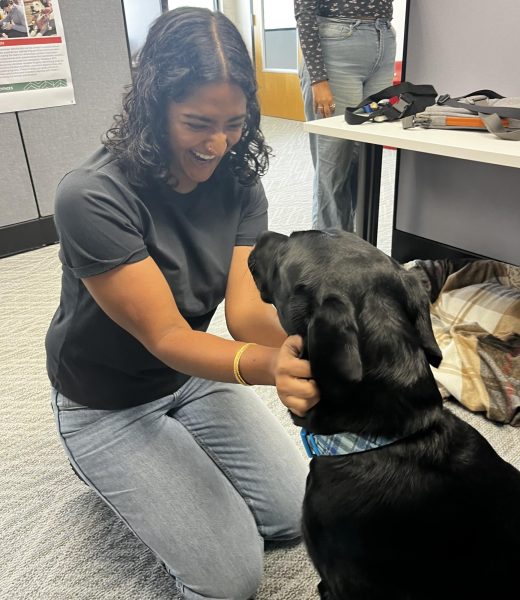
Ford attended Tufts University for her masters program and later transferred to CSU to pursue human-animal interactions. Her path to become a staff member of RISE HAI required her to broaden her idea of social work to include her love of animals and social justice studies.
Ford focuses on studying and advocating for the experiences of Black, Indigenous and people of color in RISE HAI research. She is a recipient of the Companions and Animals for Reform and Equity doctoral fellowship for her work in amplifying BIPOC and marginalized voices in her research.
“We want to create a space that is culturally aware of (BIPOC) experiences,” Ford said. “There are tons of opportunities for Black Americans to get involved with things like human-animal intervention, animal handling and animal training.”
The program’s goal is to provide opportunities for everyone and offer the support of animals. For McDonald, the hardest part of RISE HAI is acquiring the funds to continue.
“The projects that center animals, equity and community impact often fall outside traditional funding priorities, which makes it difficult to sustain them at the pace or scale they deserve,” McDonald said.
People interested in the work done at RISE HAI, especially in its applications around campus, are encouraged to volunteer. Volunteers can become HABIC-certified with their dogs or cats and support students’ mental health recovery. If someone does not have an animal, they can help train animals or work at the events put on by HABIC.
Donations are also welcome and go toward the research by RISE HAI and its resulting programs. For McDonald, Ford and Girish, effort and investment into labs like RISE HAI represent support for the future of research into human-animal interactions.
“I see this work as more than research,” McDonald said. “It’s about building a more compassionate and inclusive world, one where both people and animals can thrive.”
Reach Maiya Kreamer at science@collegian.com or on social media @RMCollegian.