Katelynn Ortega
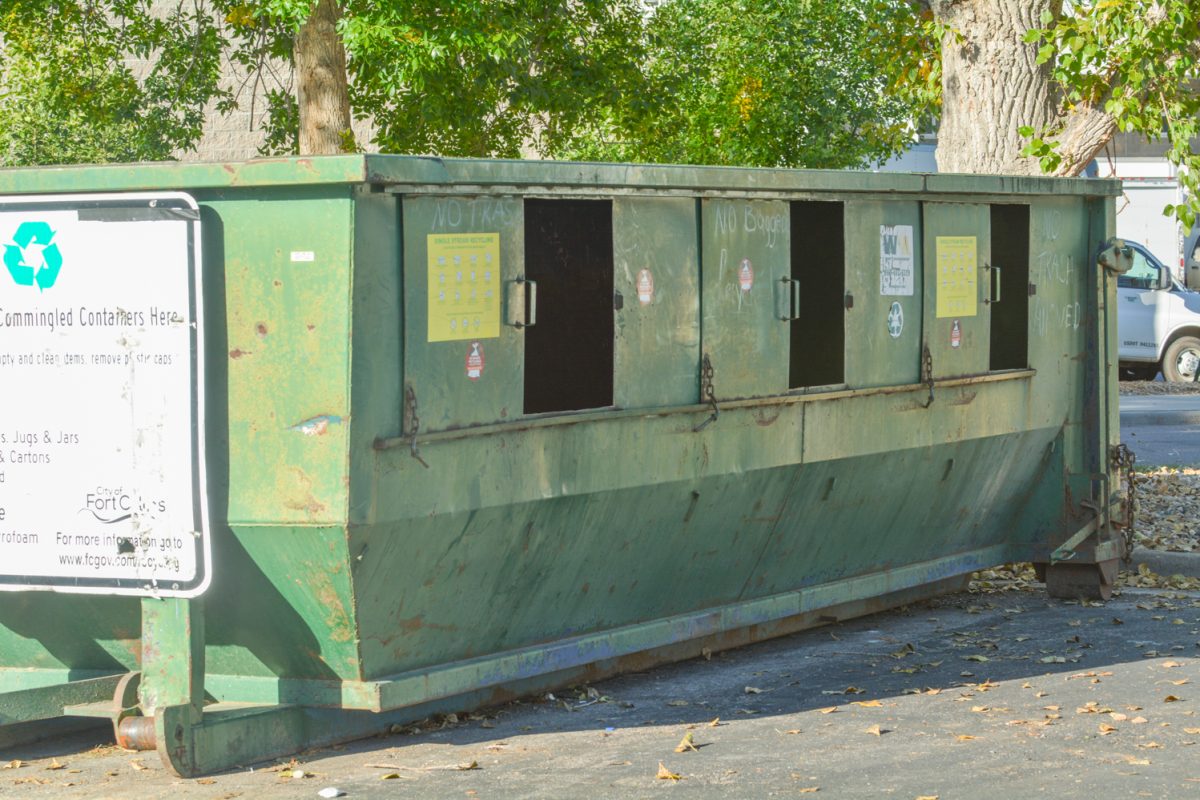
Openings of Ram's Village recycling container Oct. 2. The container is located by the O building in Ram's Village.
In 2013, the City of Fort Collins hoped to be a 100% zero waste community by 2030. As of 2025, Fort Collins will not meet those benchmark goals set in 2013. As of 2021, Fort Collins saw just a 51.5% diversion of waste, according to a city report.
However, as Micah Warners, the education and outreach coordinator for the City of Fort Collins, understands it, this is not a story of failure. In fact, the shortcoming was inevitable. Warners acknowledged that 100% zero waste diversion is a near impossible goal, explaining that most cities plateau at around 80% waste diversion.
“Before we have full-scale composting, we want to help people reduce food waste. There’s a lot of simpler behavioral changes that can be done.” -Honore Depew, City of Fort Collins climate program manager
Despite this, the city is continuing to pursue 100% zero waste status. Reflecting on stretch goals like those set in 2013, Warners emphasized the importance of mindset, especially when striving for and sustaining social change. Big goals like 100% waste diversion help capture and maintain community attention in ways that smaller, simpler goals cannot. For Warners, aiming for something like 60% waste diversion places an unnecessary limit on ambition.
“I think the benefit is that we don’t sell ourselves short,” Warners said.
Even though the 2013 Road to Zero Waste Plan proved to be outdated, new programs and infrastructure have reduced the amount of Fort Collins’ waste that goes to the landfill. A large portion of this waste diversion has happened in the industrial sector.
“Food waste is a really big deal because of the carbon emissions that it can generate when it’s in the landfill, the space it can take up and how much food waste there is in the city,” Warners said.
A large portion of waste in Fort Collins is made up of food scraps that take up precious space in landfills, release large amounts of carbon and absorb already scarce resources. Lead specialist of environmental sustainability Emily Wenger is working toward a food-waste-free Fort Collins. She spoke about the role accessibility plays in community-supported, low-waste initiatives. Last fall, the city adopted a trash and recycling program in collaboration with Republic Services that provided a higher standard of baseline service to single- and multi-family residences.
“The program allows the city to offer yard trimmings as part of the base level of service for a rate that makes it accessible to many more households,” Wenger wrote in an email to The Collegian.
Wenger said the program has been successful, with roughly 45 pounds of yard trimmings per house diverted from landfills monthly. This program, coupled with other diversion and education strategies, has contributed to the redirection of waste from Fort Collins landfills.
“The biggest challenge so far has been helping residents adjust to the new program,” Wenger said. “A lot of things about trash service changed all at once, … so there’s been a learning curve for residents, the city and the contracted hauler.”
The Fort Collins community has long valued sustainability. Both Warners and Wenger underscored the importance of community involvement and support in being able to implement these projects. In addition to working with a new trash hauler, the city signed a contract with Compost Queen to make composting even more accessible to the over 70,000 households in Fort Collins.
“This one-year pilot partnership will expand food waste recycling access and collect data to inform and shape the city’s approach to reducing the amount of food waste sent to the landfill, through offering discounted composting services,” Compost Queen outlined in a press release.
City of Fort Collins Climate Program Manager Honore Depew provided details on Fort Collins’ plan for continuing this environmental progress. In addition to signing the contract, the city has launched a behavioral change campaign aimed at raising awareness about food waste.
“Before we have full-scale composting, we want to help people reduce food waste,” Depew said. “There’s a lot of simpler behavioral changes that can be done.”
With ambitious goals, Warners said that reducing waste is achievable. However, the continued success of waste reduction in Fort Collins rests largely on the community.
“This work comes out of listening with the community and hearing from the community,” Warners said.
Reach Ella Dorpinghaus at news@collegian.com or on social media @RMCollegian.