
Connor Roche
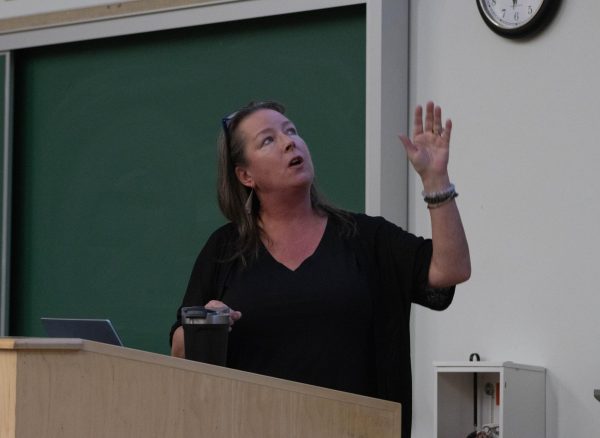
The final speaker of the Colorado State University History Club's Annual Meyer Nathan Lecture, Senior Instructor Derek Everett, addresses the room Nov. 10. "What I want to talk about this evening has to do appropriately enough, specifically the mass movement of the Ku Klux Klan." Everett said.
Colorado State University’s history department convened for the annual Meyer Nathan Lecture Series Nov. 10, hosting students and faculty from across campus to examine historical contexts and encourage conversation.
Featuring several Colorado State University history professors, the series was created to honor the legacy of its namesake, a CSU professor who passed away in 1981. Organizers said Nathan left behind a legacy of education through dialogue that inspired the history department to continue offering historical context for modern discussions.
The theme this year was “Coming Out of the Dark Times” and was chosen by officers in CSU’s history club to relay a positive message to their audience. Club President Andrew Bowman said he hoped to inspire resilience among attendees.
“Despite how dark things may feel for some today, people have constantly experienced dark times, and the human spirit pervades,” Bowman said.
Associate Professor of Instruction Erin Jordan served as the event’s first speaker, delivering a lecture titled “Women in the Crusader Kingdoms of the Latin East, 1100-1220.” She told the story of multiple women who persevered during the time of the Crusades.
“Despite how dark things may feel for some today, people have constantly experienced dark times, and the human spirit pervades.” -Andrew Bowman, CSU history club president
This tale began with Constance of France – the princess of Antioch in the early 12th century – and carried on with generations of related and unrelated women in the years after. One such story was of the young Agnes of France.
Her early life as a French princess in the late 12th century was filled with upheaval and death from age 8. After some years married to prominent male figures of the Byzantine Empire, Agnes was lost by historians. Years later she reappeared in records, married to a Greek nobleman and living in the countryside with her family.
The tale of Agnes was only one of the many Jordan told, and it was certainly not the only to center on a young woman married away only to face many struggles.
“I think for (Agnes), it is a happy ending to what was probably a very dark time,” Jordan said.
The subject of Associate Teaching Professor Eli Alberts’ lecture considered what it takes for someone to have control, not just of their personal future, but of their narrative. He spoke about rhetoric surrounding Genghis Khan and the Mongols that may have a continued effect on Asian representations to this day.
He begun by telling the story of a boy named Temüjin, whose father was killed by an Eastern Mongolian tribe confederation called the Tatars. This boy later conquered the confederation and became the founder of the Mongolian Empire, taking the name of Genghis Khan.
Alberts explained the difficulty of understanding a man as complex as Genghis Khan.
“You have stories that are entirely from the view of his supporters and the supporters of his descendants,” Alberts said. “Then you have other narratives that are from the perspective of peoples that were conquered, so you always have to balance those two out.”

Alberts also touched on the yellow peril, which was an ideology from the 19th century that framed Asian people as existential enemies of Western civilization. He explained how the opinions people derived from stories of the Mongols and others could have resulted in these strange and distorted views on the Asian population.
“Think about how narratives and representations spread,” Alberts said. “Those narratives and representations can be used to target specific groups.”
Senior Instructor Derek Everett argued bigotry of this nature is one of history’s darkest repetitions, diving head first into a more recent example through his lecture on the post-Ku-Klux-Klan era of the United States.
Everett explained how white supremacy manifested in post-reconstruction America in comparison to its time during the early 1900’s, arguing the creation of the film “The Birth of A Nation” sensationalized the history of the KKK by giving them a more exciting brand.
Everett’s analysis doesn’t find a clear moment when the klan lost its hold on the country, instead he found many dominoes that brought down key leaders of their Klan and disillusioned many to the cause.
“The attitudes don’t necessarily disappear,” Everett said. “They fade into the background until a resurgence.”
And as Everett described with the words of poet T.S. Elliot; dark times usually end “not with a bang but a whimper.”
Reach Maiya Kreamer at news@collegian.com or on social media @RMCollegian.