Cait Mckinzie
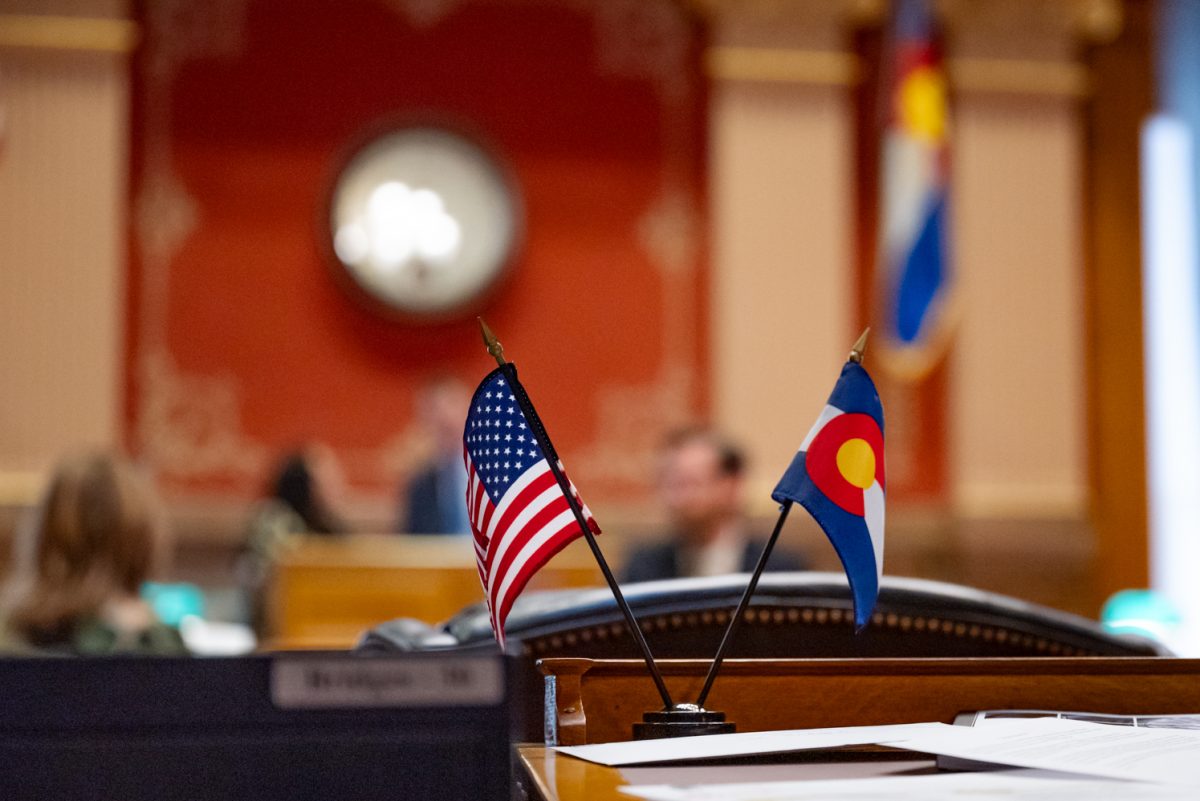
An American and Colorado State flag sit on the desk of a Colorado senator in the Denver Capitol Senate chamber during the Associated Students of Colorado State University's Day at the Capitol event March 10, 2025.
Editor’s Note: Access to Colorado Gov. Jared Polis, Speaker of the House Julie McCluskie and President of the Senate James Coleman was made possible thanks to an invitation for The Collegian to sit in on a meeting of the Aurora Sentinel Colorado’s editorial board with top Colorado leadership. Some quotes below were given to The Collegian for purposes of this article, and others were provided to the Sentinel’s editorial board. All quotes were provided on the record.
As the Colorado General Assembly legislative session began Jan. 14, a new round of bills and resolutions affecting the state of Colorado will be presented as the state legislature begins business.
Top of mind for the heads of Colorado politics — including Gov. Jared Polis and Speaker of the House Julie McCluskie, both in their final legislative sessions before their terms expire, and President of the Colorado Senate James Coleman — include the $850 million deficit the state budget is running.
A deficit that steep means new programs and services are unlikely to be funded and also bears harsh realities for higher education funding. Colorado is No. 43 in the country in terms of support for higher education, meaning institutions like Colorado State University must rely on significant sources of income from areas other than the state to foot operating costs.
The state budget shortfall comes at a time when CSU is already predicted to be operating in a deficit for the upcoming fiscal year. CSU President Amy Parsons sent out an email to faculty and staff Jan. 12, which was obtained by The Collegian.
“A recent letter to state lawmakers signed by nearly all presidents and chancellors from Colorado’s public colleges and universities estimated $61.2 million in new state funding would be needed next year to maintain current levels of service and tuition affordability,” Parsons wrote in the email. “The governor’s budget proposal would increase funding for higher education by just $10.6 million, less than 1 percent. According to the letter from higher education leaders, such a level of state funding would result in ‘A combination of tuition rate increases and budget cuts, which can harm affordability, the quality of a post-secondary education and our employees.'”
CSU is projected to be running a deficit of $38 million to $48 million for the next fiscal year, which begins in July, according to Parsons’ email.
“Over the past seven years — my time in office — we have made historic investments in higher education coming out of the pandemic. We were able to increase the pace of our investments at a much greater rate than we had years prior. But we are on lean times, and I support the idea that we have got to continue that focus on affordable pathways to a college degree. I believe that regardless of being a Democrat or Republican, we all share that value.” –Julie McCluskie, Speaker of the Colorado House
“We will continue to work with higher education leaders and other stakeholders to advocate to the General Assembly for increased state funding,” Parsons said in her email. “In the past, that strategy has been successful, but the state’s budget situation may limit what is possible.”
However, Colorado’s political leaders asserted that affordable higher education is still very much a priority.
“From the budget perspective, my budget, we want to make sure that tuition doesn’t go up more than inflation,” Polis said. “We prefer it goes up less than inflation. We’ve accomplished that. Almost every year I’ve been governor, it’s gone up lower than inflation.”
For the 2024-25 year, tuition costs increased by 3% for in-state students and 4% for out-of-state students, charging $186 more per credit hour for in-state students and $653 per credit hour for out-of-state students. This does not influence other factors like differential tuition, fees or technology charges determined by individual colleges or programs.
“Over the past seven years — my time in office — we have made historic investments in higher education coming out of the pandemic,” McCluskie said. “We were able to increase the pace of our investments at a much greater rate than we had years prior. But we are on lean times, and I support the idea that we have got to continue that focus on affordable pathways to a college degree. I believe that regardless of being a Democrat or Republican, we all share that value.”
The 2025-26 state budget included an increase that brought K-12 funding up from $9.8 billion to $10 billion, with an increase of $150 million. However, cuts were made to specific programs. Last year’s higher education funding saw a 2.5% increase of $39 million, bringing the total to $1.7 billion.
Higher education leaders projected that they would need $95.3 million for 2025-26, a sharp decrease from the funding realties; however, schools were granted permission to raise tuition. Projected request numbers for 2026-27 are not available yet.
Of the top three political leaders, Coleman is the only one who will remain in office for future years, and he affirmed a long-term commitment to education funding.
“If anything, Colorado has to have a harder conversation about the future of our needs and (ask) what should we do about revenues?” Coleman said. “How can we do a better job of guaranteeing that every demand on K-12, early childhood, higher education and all of the other important programs and services we provide, that those are available to all of our citizens at the levels that they expect?”
Reach Allie Seibel at news@collegian.com or on social media @allie_seibel_.